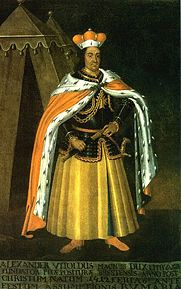
17th Century painting of
Grand Duke Vytautas
Photo courtesy Wikipedia
Grand Duke Vytautas
Photo courtesy Wikipedia
"...The portraits of Grand Duke Vytautas are beset with problems of portraiture, that do not have any iconographic
substance."
The paucity of original material in Lithuanian history before the 14th century is partly due to: Lithuania only becoming christianised between 1387 and 1413; the first Lithuanian printing only appearing in the 16th century (as used by Mažvydas in his Cathechism in 1547); the level of education and culture in the 14th century had not seeped deep enough for the Lithuanian ruling class to see the need of systematically documenting events. Although, we must remember, there were scribes for official correspondence in the ruler’s chancelleries. For example, we know that Gediminas’ letters to Pope John XXII in 1322 and 1323 were written by the Franciscan friar Berthold, who lived in Vilnius. Gediminas’ letters to other dignitaries in the West were also written in Latin. The Lithuanian Chronicles were written in the Old Slavic language and "...were preserved in various fragmentary manuscripts and records of different length and extent. They originated from the 14th and 15th centuries. During the 16th century they were compiled into more comprehensive chronicles" - (Encyclopedia Lituanica Vol I, pages 519-524). What authentic historical material has come down to us are fragments of these manuscripts and notes of chroniclers in foreign countries. In other words, many notes have reached posterity as seen or experienced by foreign scribes, who were not very often complimentary to Lithuanians.
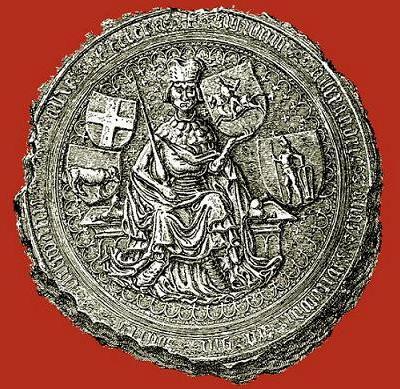
Royal seal of Vytautas the Great. Photo courtesy Wikipedia
Thanks to the Aušrininkai efforts to steer Lithuania away from tsarist Russian and Polish influence, the Lithuanian people were strengthened in their resolve to become independent. The Aušrininkai needed a symbol, a heroic personality, that would attract like a magnet people’s attention and imagination and fill their hearts with pride. Grand Duke Vytautas (- 1430) emerged as their hero and the symbol of an independent Lithuanian State. And so the year of 1930 was proclaimed the year of Vytautas the Great.
It is, nevertheless, a pity that while the nation rejoiced in his great war exploits and victories, the historians haven’t highlighted the important role that his wife, Grand Duchess Ona, played in the ruling of Lithuania and the cultural influence that radiated from her Court. The reign of her husband Duke Vytautas Kęstutaitis coincided with important events in the European history of the same period. It would be useful to recall what was happening at these times in Western and Eastern Europe:
- The popes still reside in Avignon / France in 1376
- The Hundred Years War between France and England lasts from 1337 - 1453
- The Tartars suffer a crushing defeat at the River Don in 1380
- The great schism in the Catholic Church ends in 1417. Martin V is elected Pope
- The Concilium of Constance concludes in 1418. Grand Duchess Ona dies in the same year.
These dates coincide approximately with Ona’s life. Unfortunately we still don’t know the date of her birth. However, in 2008 it will be 590 years since Ona’s death. What do we really know about her personality? Not much. The fragments that have survived invite the researcher to hypothesise. It is advisable to distinguish between fact and fiction.
The historian Narbutas and a few others believed that she was the daughter of Duke Sviatoslav of Smolensk. This theory has been rejected and the latest research points to her being the sister of Prince Sudimantas. Hence her maiden surname was Sudimantaitė.( Father - Sudimantas, mother Sudimantienė, daughter Sudimantaitė, son Sudimantaitis ). Some historians claimed that the nobles of the Sudimantas family had kinship bonds with the Gediminas dynasty.
An entry in a German chronicle states, that Prince Sudimantas was the Commander-in-Chief of Duke Vytautas’ army. It seems that Prince Sudimantas had betrayed Vytautas in the battle with his cousin, King Jogaila of Poland, in 1389. Thus, Vytautas was unable to regain his rightful patrimony Vilnius and the lands around it. Historians point out that it is rather strange, that neither his brother-in-law and nor other member of the Sudimantas family have been mentioned in the chronicles until Vytautas’ death in 1430, and then even during Švitrigaila’s rule and until the death of Vytautas’ brother Žygimantas in 1440. It may be a coincidence, or it may be, that Duke Vytautas was so disappointed by the betrayal, that every member of the Sudimantas family was barred from the Court. Or it may have been a different branch of
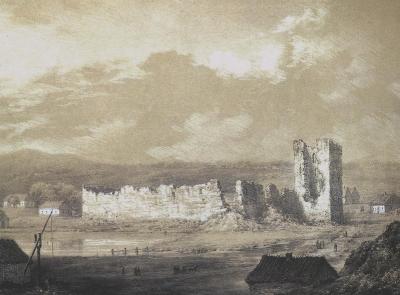
The ruins of Kriavas Castle in a 19th century lithograph by
Napoleonas Orda. Photo courtesy Vilnius University Library
Napoleonas Orda. Photo courtesy Vilnius University Library
Some historians, like Oswald Prentiss Backus, go great lengths in trying to establish that Ona was a noble woman and that it isn’t a coincidence that "Alekna or Alexander, the son of Olechno Sudimontovich...a son of pan (Mister) Sudimont Dirkgevich, a boiarin (Noble) of Sigismond Keistutovich" was related to her. (Motives of West Russian Nobles in deserting Lithuania for Moscow, 1377 - 1514, Uni. of Kansas Press, Lawrence, USA, page 147)
It has to be pointed out that nothing is known of Ona’s parents. As mentioned before, Ona’s birth place and date are also unknown. Even her marriage place and date to Grand Duke Vytautas are unknown. Historians guess that the wedding could have been approx. in 1370, for their only daughter Sophia was allegedly born in 1371. At 15 she was betrothed to Prince Vasilii, son of Dimitrii Donskoi of Moscow. In 1381 Vytautas was engaged in warfare and in 1382 he and his father Kęstutis were imprisoned by Jogaila in the castle of Kriavas. It is, therefore, posible that Vytautas and Ona lived in the castle of Trakai with Vytautas` parents from about 1370. Then from 1376 Vytautas became Duke of Gardinas and could have resided with his wife in Gardinas in Southern Lithuania.
However, we have historically accurate information about two of Ona’s sisters:
- Agripina was married to the Duke Jonas Algimantaitis of Alšėnai. Agripina was not only Ona’s sister, but also the mother of Julija, Vytautas’ second wife. Agripina’s son Andrius was the father of Julija, the fourth wife of Jogaila, Grand Duke of Lithuania and King of Poland. Jogaila was, of course, Vytautas’ cousin. It seems that a close blood relationship was not a bar to marriage in those times. Only a papal dispensation was needed.
- Julija was married to Albertas Manivydas, the Elder of Vilnius and later in (1413-1422) the Governor of Vilnius. Whether she was the first or second wife of Manivydas is still being disputed (Information supplied by Vytautas Patašius).
Ona a loving wife, a diplomat and a clever woman After Jogaila had imprisoned Vytautas and his father Kęstutis in the castle of Kriavas, Ona kept on visiting her husband. It was either she or Vytautas who hatched the plan to swap clothes and give Vytautas the opportunity to escape. Chroniclers have noted that Vytautas was clean-shaven and that he wasn’t tall. Thus their deception was successful. Vytautas left the prison disguised in his wife’s clothing with the wife’s attendant Alena. The Duchess Ona stayed in prison. Whether it was her plan, or her husband’s plan, matters little. It doesn’t diminish Ona’s love, self-sacrifice and daring, for by her act she exposed herself to Jogaila’s wrath. She definitely saved her husband’s life, for we know that her father-in-law, Duke Kęstutis, was killed in prison and buried according to pagan rites. As for the guards, they only noticed the deception a few days later. By this time Vytautas was safely across the border in Mazovia and travelled later to the lands occupied by the Teutonic Order. (Vytautas was forced twice to seek refuge with the Teutonic Knights in 1382-84 and again in 1389-92). The latter time his wife and family and even the courtiers had to flee to the proclaimed enemy in order to escape capture by Jogaila. Incidentally, the Teutonic Order bestowed the castle of Ritterswerder near Kaunas and two smaller castles nearby to Duke Vytautas in 1391.
How long did Ona remain a prisoner in the Kriavas castle is unknown. However, she eventually was freed and joined Vytautas in his haven in Prussia. We can only hypothesise how and why Ona was freed from prison. It should be noted that it was customary in those times to free prisoners for a ransom. Unfortunately, we lack concrete evidence that this happened in her case. In her case the ransom, if such was paid, must have been quite substantial. It is, therefore, most perplexing, that no document has been found shedding light on this case.
Ona must have known that by her sacrifice she was rescuing not only the husband she loved, but also the possible future ruler of Lithuania. For it was clear that Vytautas was Jogaila’s opponent, who also had legitimate claims to the realm of Lithuania. This was the source of enmity between the two cousins.
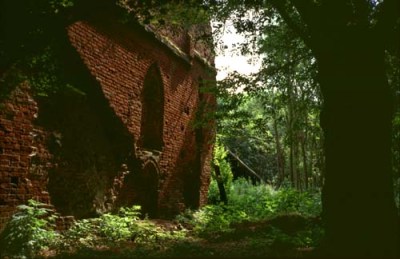
Castle ruins of Balga/Vesyoloe
The family and and their court led to all appearances an unrestricted life in Prussia. Vytautas’ and Ona’s daughter Sophie married the Grand Duke Vasilii I of Moscow. The marriage was celebrated at the castle of Balga. Ringailė was also married to the Mazovian Duke Henry at the same castle.
So 10 years of enmity elapsed between Vytautas and Jogaila, now King of Poland. It was a most turbulent period, interspersed with conspiracies and warfare between the two cousins. Ona foresaw that the only way Vytautas would regain his lands was by concluding a treaty with Jogaila. Thanks to her efforts the peace treaty was signed at Ostrow in Poland, not far from Lublin on August 5,1392. (N.B: The place name of Astravas is incorrect!). Ona had to pledge her husband’s adherence to the stipulated demands. Duchess Ona signed two guarantee documents for Jogaila, the King of Poland, and for his wife, Queen Hedwig (Jadvyga). The documents contain Ona’s seal. The iconographic depictions on the seal reveal St Ann and two figures sitting on her knees. "By this treaty Vytautas acquired control over the entire
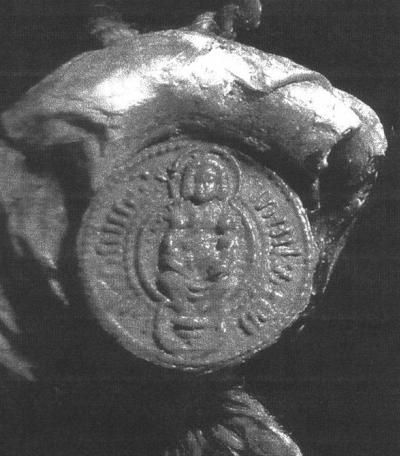
The seal of Ona Vytautienė
As mentioned before, Grand Duchess Ona favoured the alliance with the Teutonic Order. "In 1398 Ona participated in the solemn meeting at Salynas, where the peace made with the Teutonic Order was ratified" (ditto). This treaty was between Vytautas and the Teutonic Order. It was called the Eternal Peace document. This treaty was very disadvantageous for Lithuania. Vytautas pledged Samogitian (Žemaičiai) lands to the Order, i.e. all the lands on the River Nevėžis’ right side, a part of the Sūduva region and lands in the north west of the River Šešupė. It should be noted that this gift of lands to the Teutonic Order was not the only time that Vytautas gave Samogitia to the Order.
It is intriguing to note that Ona was not a signatory of the Eternal Peace treaty. It could be surmised that she remained a free agent who could be a go-between, if necessary, between the two cousins, Vytautas and Jogaila.
Grand Duchess Ona a Christian
Although history has not revealed the date of her baptism and her pagan name, but there are numerous mentions that she was a very devout Christian. When she died in 1418, the Grand Master of the Teutonic Order gave the order to hold Holy Masses for the salvation of her soul in all the churches of his lands. Her husband Vytautas left in his will the region of Humenis to Bishop Matthew of Vilnius, to pray for him and his successors and the souls of his two wives Ona and Julijona.
Johannes Reymann, who witnessed the miracles of St Dorothy, has stated that: "he saw the Duchess with Žygimantas, the brother of Vytautas, and numerous courtiers visiting the grave of St Dorothy at Marienwerder." According to him: "The Duchess was very devout (pious) and made a donation of expensive fabrics and other gifts." Johannes Reymann also stated "That during the Duchess’ tour and visits of the Teutonic Order castles, she was greatly pleased to receive two books about the life of St. Dorothy: ...ad quo duxissa erat valde affecta propter devotionem."
The question obviously arises why was the Duchess happy to receive two books about the Saint? It should be noted that, with a few exceptions of course, kings and queens were not as literate as we usually assume. Besides it was customary for a monarch to ask for a Saint’s relic and to receive as a gift a sliver of his/her bone. Now, Grand Duchess Ona was given two books and she was pleased to receive them. We might as well ask what type of books they were. It is usually asumed that any book printed before the 15th century was an incunabulum, which had a beautifully enhanced letter at the beginning of the chapter and in many cases an appropriated picture as well. Could Ona read? Perhaps, or she might have had a courtier who could have read it to her and her Court. The language of these two books
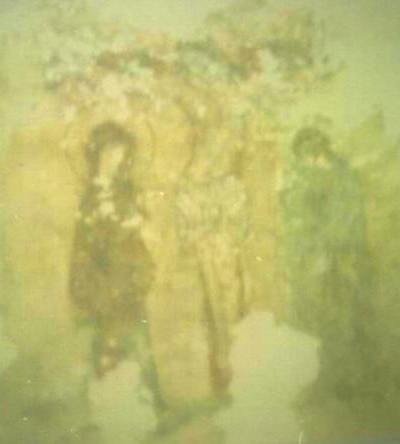
An ancient fresco in the crypt of Vilnius Cathedral,
thought to have decorated the tomb of Ona
thought to have decorated the tomb of Ona
It is intriguing to speculate about the cultural level at the Court of Grand Duchess Ona. The Grand Master of the Teutonic Order, Ulrich von Jüngingen, sent her two musical instruments in 1408: one was a Clavichordium (a keyboard instrument consisting of a number of thin wire strings struck from below by brass tangents - a small piece of metal that strikes the strings) and a Portatyvum (small portable organ with arm - operated bellows, popular in medieval times). Why would the Grand Master make a gift of such expensive musical instruments? Obviously, he wanted to cultivate a friendly relationship with Ona, the wife of Grand Duke Vytautas. Yet, a gift is also chosen to give pleasure to the recipient. Ona must have liked music. She had resided with her husband in the lands of the Teutonic Order during the two flights from the victorious Jogaila, who later became King of Poland. She was perhaps used to having music at her Court, i.e. at the Balga castle in Prussia. It is possible that Ona could perhaps play them herself, or had someone at her Court to play them and entertain the guests.
The next gift is even more perplexing. In the account register books of the Teutonic Order a further gift for Ona was entered: "Good wine from the Rheinland and grapes were sent to the Grand Duchess in 1416." This was six years after the famous battle of Tannenberg (or Grünewald, or Žalgiris) in 1410, which ended in a victory for the combined forces of Lithuania, Poland, their allies and mercenaries. It is obvious that the Order valued Ona’s goodwill. Grand Duchess Ona maintained this good relationship as a counterweight of King Jogaila’s and especially the Polish nobility’s efforts to hold in check Vytautas’ struggle to become King of Lithuania.
The following facts, additional to those mentioned before, seem to support the astuteness, diplomatic ability and cultural level of Grand Duchess Ona:
- Grand Duchess Ona visited the lands of the Teutonic Order in the lower part of the River Vistula (Wisla in Polish) in 1400. She was greeted with great pomp and ceremony. She also received many precious gifts. She never made any such tour in Poland! Such an unusual fact would have been noted in some chronicle.
- Grand Duchess Ona and her husband’s cousin, the Duchess of Mazovia, must have been wearing beautiful clothes during their extended visit in the lands of the Teutonic Order. This fact is mentioned a number of times by the Teutonic Knights.
- The French traveller, Ghillebert de Lannoy, who visited Vytautas’ Court during the years 1413-1414 also gave a very complimentary account of the Grand Duchess’ many qualities.
- The Grand Master of the Teutonic Order gave an undertaking to defend Ona’s rights and the lands that Vytautas gave to her, should Grand Duke Vytautas die before her.
- It appears that Vytautas and Ona were used to giving expensive gifts to potentates they visited. When visiting the Holy Roman Emperor Sigismund and his wife Barbara von Cilly, the Grand Duchess Ona gave the Empress shoes embroidered with pearls, towels decorated with gold threads and sable fur gloves. Grand Duke Vytautas gave the Emperor 100 fine steeds, a great deal of expensive furs and other gifts. N.B: It should be borne in mind that Vytautas and Ona wanted to influence the Emperor to support Vytautas’ wish to be crowned King of Lithuania. The Emperor not only supported this decision, but he actively propagated it as a lever against the further expansion of Poland in the region.
- When Vytautas and Ona were on their way to Cracow in Poland to visit King Jogaila and Queen Jadvyga (Hedwig), they gave a silver cradle to their daughter Bonifacia Elisabeth, born on April 22,1399. Mother and daughter died soon after Grand Duke Vytautas’ and Grand Duchess Ona’s visit.
- It is also known that Vytautas and Ona gave a lavish wedding banquet to their granddaughter Anastazija who married Duke Alexander of Kopil in 1417.
Isolde Poželaitė - Davis AM
"I wish to express my gratitude to Vytautas Patašius, who supplied information on the sisters of Grand Duchess Ona and gave me valuable advice on the topic."