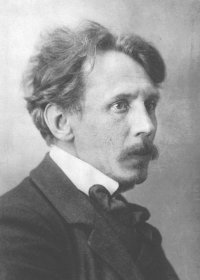
M.K.Čiurlionis
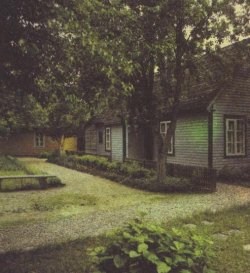
The Čiurlionis family home in Druskininkai.
In summer it hosts numerous concerts
In summer it hosts numerous concerts
Mikalojus Konstantinas was the eldest son of Konstantinas Čiurlionis, a church organist who had nine children. All the children were taught to play a musical instrument by their father. Music played on the harmonium and on other instruments filled the house. His mother, Adele Ona Marija Magdalena née Radmann, was the daughter of Octavio Radmann, a migrant from Bavaria. She had a vivid imagination, a good voice and liked to sing and to tell stories to her children. The stories and songs young Mikalojus Konstantinas heard growing up have had a great influence on his later creative expression in music and in painting. The often-occurring echoes of stories and other imaginary themes of castles, seas, waves, figures on the bottom of the sea, world creation and the heavens, with their myriad of stars, abound in his music and paintings. Furthermore, a cycle of paintings has quite often a counterpart in music and vice versa, eg. the music movements of the sonata The Sea have counterparts in the cycle of paintings The Sea.
At the age of five Mikalojus Konstantinas could play by ear and very soon had mastered playing written music from notes. The young composer’s talent was noted and groomed at the Duke Mykolas Oginskis orchestral school at Plungė. In 1893 he was accepted at the Warsaw Conservatorium, which he finished in 1899. Then in 1901 he went to Leipzig, Germany, to further his studies, again financially supported by the Duke. Unfortunately, the Duke died a few months before Mikalojus Konstantinas was to finish the Leipzig Conservatorium. His friend E. Moravski came to his aid and supported him financially until he finished it in 1902.
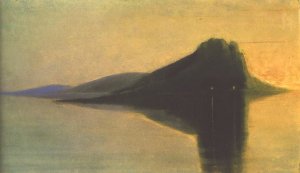
"Serenity", 1903/4, 42.2 x 72.7; paper, pastel
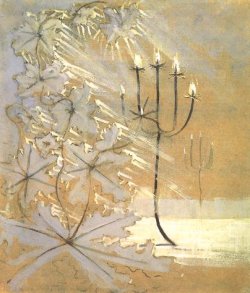
From the cycle "Winter" 1907,
36.6 x 31.3; paper, tempera
36.6 x 31.3; paper, tempera
At the same time he was a welcome guest at the musical entertainment evenings of the Wolman family in Warsaw, where he played many of his now numerous works. As time went by, he became a close family friend and travelling companion. They went to the Crimea and to the Caucasus. The Wolman family sponsored his grand tour of art galleries in Prague, Dresden, Nürnberg and Vienna. Seeing so many great painters and their works through the centuries woke in him an irresistible yearning to take up painting. As a result he began studying visual arts at the Warsaw Academy of Art during 1904 - 1906.
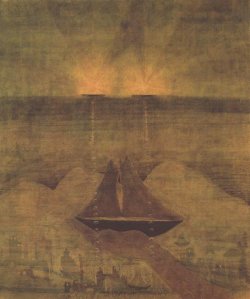
"Sonata of the Sea, Andante" 1908,
73.1 x 62.2; paper, tempera
73.1 x 62.2; paper, tempera
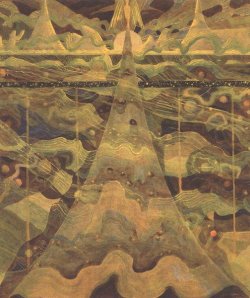
"Sonata of the Stars, Allegro" 1908,
72.2 x 61.4; paper, tempera
72.2 x 61.4; paper, tempera
Realism didn’t hold much attraction for him. Neither did Romanticism. However, a few pictures in a Romantic style tinged with lyricism and melancholy are: The triptych Raigardas (1907), The Crosses of Samogitia, The Cemeteries (1909) and a few others. Most of his paintings are painted in an unusual, very original "dreamlike" style with a subtle colour scheme. According to entries in the Encyclopedia Lituanica, Vol. I, pp. 541-549: "Čiurlionis emphasised (in his paintings) the melodic undulation and rhythm of lines and the use of subtle colouring".
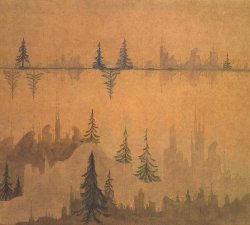
"Fugue" 1908, 62.2 x 72.6; paper, tempera
Čiurlionis’ interest in photography and developing photographs was unveiled in the recent exhition in Šiauliai, Lithuania. Jonas Nekrašius writes in the newspaper "Šiaulių kraštas," 30.11. 2005: "Visitors to the exhibition were confronted with photographs from the shores of the Black Sea that Čiurlionis did in the summer of 1905: sailing boats, fishermen at work, mountains, rocks, vast sea vistas, snapshots of local inhabitants and visitors." J. Nekrašius concludes that inherent traits of his art are also reflected in his photographic work: "...a subtle composition, the artist’s philosophical ideas, the mysteries of nature as well as the meaning of time and harmony of the universe." In the same exhition were also photographs of Čiurlionis’ parents, friends, acquaintances, landscapes and every day activities. The artist liked to develop his photographs in the darkroom that he had in the cellar of his parental home in Druskininkai, Lithuania. It seems that Čiurlionis indulged in photography from 1905 to 1909, although this time span cannot yet be determined with absolute certainty. There is, however, evidence contained in a letter to his wife, Sofija Kymantaitė, dating from 1909, that he was developing family photographs.
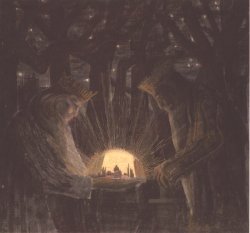
"Fairy Tale of Kings" 1909,
70.2 x 75.3; canvas, tempera
70.2 x 75.3; canvas, tempera
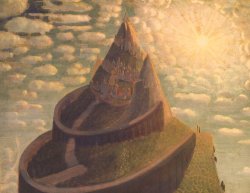
"Fairy Tale of Castle" 1909,
49.6 x 67.1; cardboard, tempera
49.6 x 67.1; cardboard, tempera
Čiurlionis’ pictures were exhibited for the first time in the Art Academy of St. Petersburg in 1906.The same year on 27 December his pictures were exhibited in the first Lithuanian Art Exhibition in Vilnius. His enthusiasm for painting went hand in hand with his love of composing. Čiurlionis became an active member of the Lithuanian Art Society’s Music Department and conducted the choir Rūta ( the Rue - Lithuania’s national flower), composed many songs based on folk songs, harmonized folk songs, wrote articles on the arts in the Lithuanian press. He had his second solo exhibition of some 60 pictures in Vilnius in March 1908. Unfortunately, the visionary quality and originality of his paintings were not appreciated by the public.
Disappointed with this failure, Čiurlionis returned to St. Petersburg. Later of that same year his pictures were exhibited in the Appolon Art Journal exhibition and favourably reviewed by Russian art critics A. Benois, V. Tchudovsky and V. Ivanov. Unfortunately, time was running out for the talented artist. His living conditions and his health were
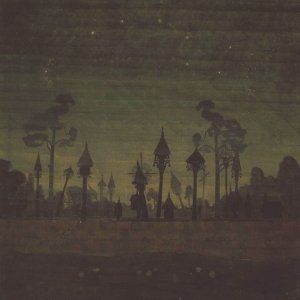
"Lithuanian Graveyard" 1909,
61.5 x 62; cardboard, tempera
61.5 x 62; cardboard, tempera
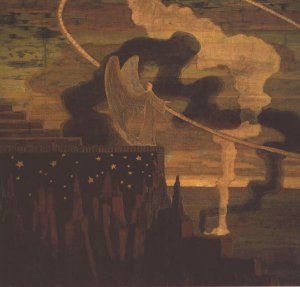
"The Offering" 1909,
71.0 x 78.5; canvas, tempera
71.0 x 78.5; canvas, tempera
His popularity as a painter and composer has been growing ever since his death. It is also worth noting that the Russian Arctic explorer Georgii Sedov named the high rock range on the coast of Franz-Josef Land Mikalojus Konstantinas Čiurlionis in 1913, because it reminded him of the artist’s picture "Serenity".
Bibliography:
1. Alijušas Grėbliūnas (Ed.), "Mykolas Konstantinas Čiurlionis - Paintings, Sketches, Thoughts" (English Edition Eds. Raimonda Murmokaitė, Christopher John Barnard), Fodio Publishers, Vilnius, 1997.
2. Vytautas Landsbergis, "M.K.Čiurlionis - Time and Content", (translated form Lithuanian by Olimpija Armalytė), Lituanus, Vilnius, 1992.
3. Genovaitė Kazokas, "The Life and Work of M.K.Čiurlionis", MA Thesis, University of Sydney, 1982.
4. Vytautas Landsbergis, "M.K.Čiurlionis: Pasaulio Sutvėrimas", Vaga, Vilnius, 1973. Texts in Lithuanian, English, German, French, Russian.
5. Antanas Venclova, "M.K.Čiurlionis", Vaga, Vilnius, 1972. Texts in Lithuanian, English, German, French, Russian.
6. "Encyclopedia Lituanica", Vol. I, pp 541- 549. Text in English and bibliographical notes.
7. N.Vorobiev , "M.K.Čiurlionis: Der litauische Maler und Musiker", Kaunas-Leipzig, 1938