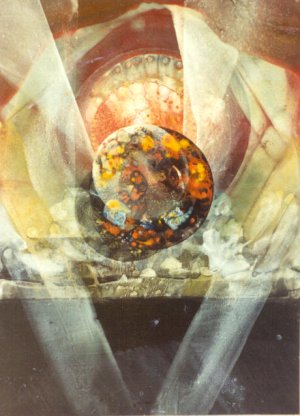
Leonas Urbonas, Conception,
1982 acrylic on hardboard, 40" x 30"
(Successful entry in The Blake Prize, Religious Art)
1982 acrylic on hardboard, 40" x 30"
(Successful entry in The Blake Prize, Religious Art)
Urbonas is perhaps best described as 'a child of his time', revealing in his widely varied work his dynamic, passionate individuality and the many personal relationships he has had. He says that 'for better or worse, I always created for the beautiful women in my life.'
Basically he is an abstract painter, but it is possible to detect in his work aspects of surrealism, action painting, hard-edge and mysticism. Everything he does combines to produce something new and fresh, making his work unique and worthy of the adjective, 'Urbonian'. Donald Brook writes that 'Leonas Urbonas ... is a painter with a turbulent, romantic imagination that functions best under close restraint. His smaller ... works have the same sort of complexity and evocative power as a high voltage spark curtain, as a map of nerve ganglia.'
In Urbonas's art, key concepts are spontaneity, subconsciousness, ecstasy, trance, vision and fantasy. These are embodied in his paintings, and to a lesser degree in his sculptures, in the complexity of line, form and movement and in the visual release of emotional and mental energies.
He was born the second son of Ignas and Uršulė (née Širvytė) Urbonas on 19 April 1922 in the Zarasai county of North-Eastern Lithuania. His father owned a small farm comprising five hectares of swampy land and, despite the supplement of his shoemaking trade, could barely earn enough to feed the family of four children. In the summers the father worked on other people's farms and during those times the family moved frequently from one village to another. During the Depression of the 1930s, Urbonas senior found himself without work and took his family to live with his cousin who had four children, among them the future poet, Paulius Širvys.
Urbonas's childhood memories, however, are not of hardship but, rather, of his father's enthralling winter tales of ghosts and the spirits that the children believed were surrounding them, of family singing, of picturesque lakes and forests, of snowfields transforming the landscape into strangely beautiful vistas. Urbonas writes: 'As long as I can remember I was bewitched by the beauty and mystery of Nature.' He was fascinated also by the worlds that he and his cousin Paulius, inseparable friends and avid readers, found in books. He did well at school, and from the age of fourteen, supported himself by tutoring other children. At high school he impressed with his retentive memory and his talent for representation. His high school art teacher Belzakiene and her husband, music teacher Belzakis, recognised Urbonas's talent and advised him to concentrate on visual art. They provided him with paints and other art materials.
He completed studies at Zarasai High School in 1941. By this time the Nazis had closed tertiary educational institutions and ordered young Lithuanian men either to form an SS battalion and fight on the Russian front or go to Germany to work. Urbonas hid on his father's farm. In 1944 he joined the wave of refugees fleeing to the West, and was captured and taken into the German army where he acted as an interpreter.
After the war he reached a refugee camp in the German town of Hanau where about 4,000 Lithuanians were housed in a former military barracks. Urbonas volunteered to help repair one of the buildings in order that an art school could be established in the camp. The teachers were Mikas Šilelis, who lectured on history of art, Kostas Jezerskas, on drawing, and Juozas Kaminskas, on painting. Besides Urbonas, students included Balys Milaknis, Vytautas Ignas, Jonas Kelečius and others, twelve future artists in all. Art materials were provided by UNRRA. Urbonas attended this institution during 1945 and 1946 and then enrolled at Staatliche Akademie der Bildenden Kunste (State Academy of Creative Arts) in Stuttgart. There he learned much from the great teacher of abstract art, Willi Baumeister who, because he was an abstractist, earlier had fallen from Nazi favour. The other teachers were realists and required traditional academic drawing and classical composition.
In Stuttgart, Urbonas met Estonian playwright Talva Tuldar who bore him a son, Tauras, in 1947. In 1948 Urbonas migrated to Australia and, on completion of his work contract in Queensland's sugar cane plantations, took a job as a shift-work polisher and electroplater in a factory at St. Peters in Sydney.
In 1957, he and Tuldar separated and their son remained with his mother. In his loneliness, Urbonas turned to art and psychological, philosophical and spiritual literature, especially the mystic, Eastern religions. He formed a close friendship with another Lithuanian, graphic artist Algirdas Šimkūnas and at Šimkūnas's suggestion, joined the Sydney Contemporary Art Society in 1958. He belonged also to the Metropolitan Motor Scooter Club and to the Divers Club. Many weekends were spent on excursions to the mountains or diving in the waters around Sydney. He says that these experiences gave him inspiration for his paintings.
From the beginning of his artistic career in Australia in 1958 until the present time, Urbonas's work has undergone a number of changes. It is possible to identify four partly overlapping times: 1958 to the end of the sixties - a searching period; the seventies - a biomorphic period; the early eighties - a sonorous period; and from the mid-eighties - an abstract sculpture period.
In the first period he searched for an individual style. Although Urbonas was familiar with abstract art, especially from his association with teacher Willi Baumeister, he did not practise it until he came to Australia. The growing interest of Sydney artists in abstract art, especially following the 1953 French Painting Today Exhibition, and his discussions with Šimkūnas were important factors in determining Urbonas's decision to work in abstract style.
He began to exhibit in group shows held by the Contemporary Art Society and the Macquarie Galleries and in competitions such as the Archibald Prize Exhibition, as well as in charity shows. In 1959, he received his first award: a 'Highly Commended' in the Rockdale Art Society Exhibition for a semi-abstract oil, The Call. He says that to prove to himself that he had the ability to paint in academic style, he entered a pastel painting, Mother, 1959 in the Mosman Council's Art Exhibition and gained first prize. Although satisfied by the result, he did not return to realistic painting.
In 1961 Urbonas met New Zealand model, June Sutton, his future wife, who became a great inspiration. She urged him to paint on a large scale as this was a current trend. Consequently, in 1963 Urbonas painted his first three large works, On the Threshold, Under Capricorn and Threshold, which he exhibited with the Contemporary Art Society. On the Threshold was included in an interstate travelling exhibition that followed the Sydney showing, and attracted the attention of art critics. It is a fantasy landscape, rendered in brown monochrome illuminated with golden yellow. The broad, irregular floating planes divided by rhythmic, dark folds of colour create a dream-like image of an enchanted place beyond worldly reality and illuminated by lightning for a fraction of time. This transient scene is permeated by a romantic and mystical atmosphere.
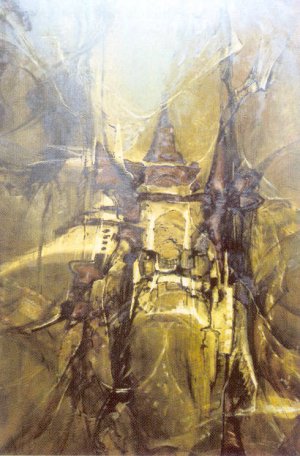
Leonas Urbonas, On the Threshold,
1963 oil 177 x 120 cm. Collection G. Kazokas
1963 oil 177 x 120 cm. Collection G. Kazokas
In Under Capricorn, 1963, the volcanic eruption of the subconscious manifests itself in agitated tornadoes, whirlpools and vortices. The undetermined forms collide blindly with each other, the colours gushing in clouds and dripping across the large painting. James Gleeson writes, 'The mood is invariably molto agitato ... Nothing is fixed and still, and this is disconcerting when you have the feeling that the paint is really describing earth and rock ... It is this irrationality that links Urbonas with the surrealists.'
It would be possible to describe Under Capricorn as an action painting were it not for the frequent ambiguous metaphors that evoke contradictory images. It seems as if inhibited powers are being unleashed. The artist describes his creative process: 'The fervour of experimentation captivated me completely ... All I cared for was to follow the visions and images as fast as they appeared ... I tried to listen only to the most spontaneous impulses ... and found it possible to will oneself into a creative, trance-like state.' And indeed, this 'fervour of experimentation' was followed by masses of new, large paintings, all emphasising different structural elements: movement, rhythm, colour splashes and indescribable shapes.
Urbonas had now developed a painting technique requiring a new approach and new tools. He explained that he would lay rolls of paper across the garage floor, and have ready several buckets of paint. As well as paint brush and palette knife, he used a vacuum cleaner, garden hose, timber slats, a household broom or a bricklayer's trowel. By manipulating this equipment he was able to control his painting of large areas and form colour folds, vary the intensity of the paint and produce sweeping, undulating shapes.
To enrich the texture, he often sprinkled sand, cement or sawdust on the paint; drops of methylated spirit were also used to create subtle highlights. These large creations became the bases for further work with paintbrush when the artist would make full use of artistic accident to convey his predominant theme: the metaphysical journey from darkness to light. This is particularly obvious in the painting, June, 1965, where Urbonas introduces a lit opening in the midst of darkness. In the same contemplative mood are Enlightenment and Revelation, both 1966. These 'soulscapes' echo vestiges of the meditative aspects of Lithuanian mythology. The yearning for the unknown and eternal is like the resonance of slow, sad Lithuanian songs ascending from the artist's subconscious to the surface of reality.
Most of his paintings from this period are strongly structured, probably influenced by the coolness and objectivity of the hard-edge approach, but show also an intensity of emotion. There is no sharp division of style in Urbonas's paintings of this period: as well as those already mentioned, there are turbulent, volcanic paintings such as Autumnal Rays, 1966. Although generally his use of colour is restricted and many paintings are executed in sombre monochrome, in others bright highlights sometimes emerge from dark backgrounds.
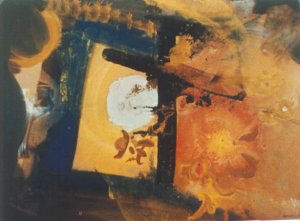
Leonas Urbonas, June,
1965 acrylic 55 x 70 cm. Collection June Usher.
1965 acrylic 55 x 70 cm. Collection June Usher.
About this time Urbonas, encouraged by his growing success, gave up his factory job to become a full-time, freelance artist. He painted hundreds of pictures so quickly that later, on examining them, he says it seemed as if he were seeing them for the first time. He recalls that he felt as if in a whirlpool, eager to follow a subconscious urge to register his visions, emotions and aspirations. His volcanic, impassioned work impressed visiting American art connoisseurs and collectors, and their purchases of his paintings gave him further encouragement. After six one-man shows, highly favourable reviews and many awards, Urbonas aspired to greater recognition in the United States, the country, he says, 'where the waves of art rise, but not where they finish.'
In 1966, he left by himself for Chicago, taking with him 250 of his paintings, rolled into a large bundle. There the Lithuanian community helped him prepare his pictures for an exhibition in the Čiurlionis Gallery. This was a great success and encouraged the artist to prepare for a forthcoming international show at the QANTAS Gallery on Fifth Avenue in New York. In a city with hundreds of art galleries and thousands of artists seeking recognition, Urbonas nevertheless drew attention. He was included in the New York Times list of exhibitors and favourably mentioned in other sections of the New York press. At an international exhibition, The Thirty Five, held in Palm Springs, California in 1967, Urbonas's paintings were hung alongside those of Picasso, Salvador Dali, Diego Rivera, Nag Arnoldi and Rodriguez. Probably his most enthusiastic reception was at Cleveland's Gallery International. It is interesting to note how art critics cope with unfamiliar work. Art critic Marie Kirkwood likened Urbonas's mystic work to Australian Aboriginal art which, she said, 'relates to symbolism unknown to the rest of the world.'
Another art critic, Katherine White, wrote: 'He uses a range of techniques including finger painting, carving thin layers of pigment with knives, folding paper over wet colour to let pattern splurge at will, and using big flexible brushes to flow over a surface. His pictures are like the dark centres of dreams, full of forgotten textures and emotions. The stuff is powerful, unimpeded, done at high risk with a rich and lively eye.'
Australian correspondents sent enthusiastic reports back to Australia, but, as the artist found later, most of these were never published. Urbonas became a celebrity in the United States and parties and dinners were arranged in his honour. He says he again fell in love and neglected invitations from millionaires and art collectors. He writes, 'Love is power. Through love one finds out more of oneself.' An exhibition of his work in Toronto at the Gallery Yonge in 1967 was a great success and all his paintings were sold. This motivated him to prepare for another Canadian exhibition and during one night, working in what he has described as a trance-like state, he painted sixty large pictures.
Soon afterwards, the artist returned triumphantly to Australia. For a time he painted in series and exhibited in the Macquarie Galleries in Sydney. During 1969, Urbonas produced some two thousand small-dimension pieces, many of them rendered with agitated, passionate emotion and having minute, decorative detail. Others are more sober, as in the 'Links' series, 1969, where the compositional elements, beautiful and sonorous in themselves, are arranged in rather classical manner. All works show a fluent and effortless technique.
James Gleeson writes: 'The paintings of Leonas Urbonas are remarkable for their extraordinary inventiveness. He is an astonishingly prolific painter, and for the opening day of his exhibition he is showing 16 large paintings, together with a group of smaller works which are to be changed daily until 173 of them have been shown. Works like Link, Limit, Circle, and Transfiguration venture into new areas, but they do so with the assurance and authority of someone who has found in them a form of expression that is completely congenial to him.
Although his Australian reception was warm and reviews favourable, the success he had had in America lured him back and in late 1969, together with his wife June and 520 paintings, Urbonas set out for North America for a second time. During eighteen months there, he held eleven one-man shows in Toronto, Chicago and San Francisco, mainly for Lithuanian communities. Following an exhibition in Cleveland, Roger Welchans, Head of the Fine Arts Department of the John Carroll University, invited him to accept a position as artist-in-residence. However, he says he declined the offer because he had lost his heart to a beautiful Lithuanian nun, Elena, half his age, whom he decided to take to Australia. Their son Aras was born in Sydney in 1972.
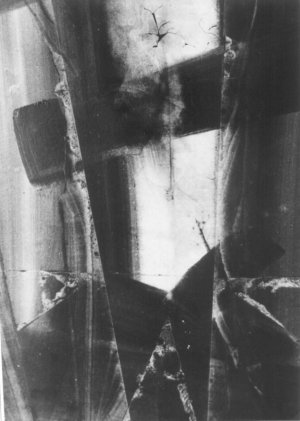
Leonas Urbonas, Enlightenment,
1966 acrylic 91 x 121 cm
1966 acrylic 91 x 121 cm
From time to time Urbonas departed from his 'high voltage' works and produced pristine and minimal studies, imbued with innocence and lucidity, such as Calligraphic Sketch, 1974. As well as painting at this time, with help from Elena he wrote and published his first essay on subconscious creativity entitled 'A Journey into the Subconscious.' During this period he participated as well in art seminars and workshops and delivered art lectures.
In 1974 he was asked by the Newcastle Society of Artists to join Stan Ostoja-Kotkowski, Reinis Zusters and others in a series of lectures and demonstrations at Newcastle University and, as well, he provided the Lithuanian press with a seemingly inexhaustible supply of art news and his personal observations about art forms and art movements. His relationship with Elena did not last and they separated in 1975. Urbonas took this as a personal catastrophe. Alone again, he concentrated on spiritual studies, on intense writing and on mysticism.
In his third period: Urbonas's pictorial work slowly took on a different character: he learned to say more with less. A conscious and cautious approach became evident in carefully balanced composition, fewer pictorial elements, sparing yet effective use of colour and barely perceptible movement. In Far Call, 1982 Urbonas depicts cosmic events with assurance and affection yet free from turbulent, ardent passion, the burden of which is replaced by a newly acquired serenity. He uses his virtuoso technique more deliberately and achieves subtle and amazingly varied textures. In the eighties the movement in his pictures is no longer molto agitato but rather andante cantabile. It seems that the spiritual serenity, so vehemently sought, has been found.
In his fourth period, during the eighties, Urbonas's pictorial output decreased as he directed all his physical energies into the establishment of the Aras Art Centre, five acres of bushland in the Mittagong area which he envisages as an informal art school and a gathering place for artists of the future. Lack of finance slowed progress yet Urbonas has eventually turned his bushland into 'five acres of art work' with landscaping, ponds, rockeries and sculptures.
His sculptures are abstract constructions in two basic media: found objects and stone. Those made from found objects are welded, some with open design and others solid structures in fantastic shapes. All are based on sound constructive principles, for example, Twins, 1977.
Equally impressive are the stone sculptures which are large-scale and form an integral part of the landscape. Some are eight or more metres in length and up to five metres in height. The artist describes them as 'pictures in space', able to be viewed from many perspectives and always surprising the observer with their diversity. Their 'total-art' concept includes, in addition to boulders and river stones, cement pedestals, the music of flowing water and reflections in ponds. One example is Singing Wall. This monumental structure gains its name from the sounds of the water flowing down the four levels of the miniature waterfall forming part of the sculpture. Singing Wall is an evolving structure, the final form of which has not yet been decided by the artist. The solid section comprises a number of asymmetric columns of varied sculptured shapes decorated with an abstract design in black and red slate and crowned with sandstone boulders. The beauty of the single elements is combined into one dignified entity, the interrelationship of mass and space enhancing further the powerful and emotional creation.
Urbonas's sculptures, like his paintings, are unique and profoundly personal statements. They have become a special feature of the Aras Art Centre which is now a popular tourist attraction. By 1988 it has been visited by about 5,000 local and overseas people. Annual art shows are held there. Urbonas has frequent philosophical discussions with visitors. He also practises as a clairvoyant, claiming to possess healing powers.
Urbonas had taken an active part in local cultural life. As well as regular art exhibitions at 'Aras', he has organized five one-man shows in the Berrima Gallery, taught art for a year at Mittagong Girls High School, delivered a paper, 'Building in a Large Landscape' at an Architects' Convention in Bowral, donated his work to local charities, and written on matters of art, spiritual life and ultimate human aims. For all that, he says he feels excluded from the cultural mainstream and believes that his talents are not being fully utilised. He often says: 'Use me, just use me'. In an interview, Urbonas was asked, 'What is art?' He answered without hesitation, 'Art is adventure and discovery of other worlds unknown even to the artist.'