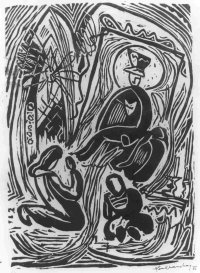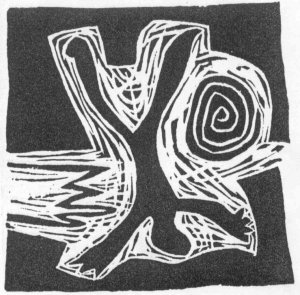
![]() Henry Šalkauskas, The Search,
1950 linocut, 17.5 x 17.5 cm. Collection Eva Kubbos ![]() Henry (Henrikas) Šalkauskas,
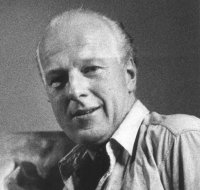
Photograph by David Moore The only child of Henrikas and Ona Šalkauskas, he was born on 6 May 1925, in Kaunas. His father was a major in the Lithuanian army, his mother a medical student whose studies had been interrupted by war. She had a great liking for poetry and the arts. The strongest artistic influence on Šalkauskas, however, was his uncle, Eugenijus Šalkauskas, whose watercolour painting fascinated the young boy. In 1940 Šalkauskas was attending Aušra Boys High School in Kaunas when the first Soviet invasion occurred. His father was arrested and deported to Siberia and his three uncles were killed. One of them, Ceslovas Šalkauskas, a farmer, was tortured to death by the retreating Communists in the June 1941 massacre in the forest of Rainiai. This aroused such terror that surviving members of the family made plans to escape as quickly and as far as possible from the Communists. In 1941, during the German occupation of Lithuania, Šalkauskas and his mother left Kaunas and settled temporarily in Danzig in Northern Germany where he studied graphic art at the Meisterschule der Deutchen Kunst. During the last year of the war the massive German mobilisation, Volksturm, took place and all male students, including Šalkauskas, were taken into military service. He later became a prisoner of war of the Americans until the end of the war. From 1946 to 1948 he continued art studies at L'Ecole des Arts et Metiers. His drawing teacher, Vytautas Jonynas, his graphics teacher, Telesforas Valius, and his watercolour teacher, Adomas Galdikas, had been well known artists in Lithuania and winners of international awards. As there were a number of German university places allocated to foreign displaced persons, Šalkauskas was able to enroll at Freiburg University where he attended Art History and Philosophy classes. In 1949 Šalkauskas and his mother migrated to Australia where he was required to fulfill a two-year contract working at a quarry near Canberra. ![]() Henry Šalkauskas, Three Women,
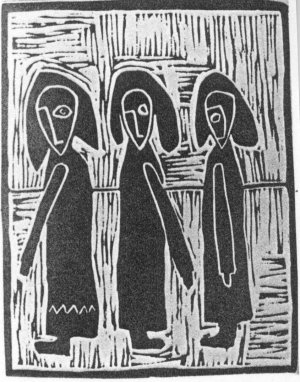
1953 Linocut 25.4 x 19 cm. Collection Ona Šalkauskas Combining the symbols of the sun and wreath of rye and placing the combined symbol centrally within a large, solid square, the artist honours the holiness of the sun and the spirit of the rye. At the periphery, with quick rhythmic strokes, he represents the opulence of the harvest. Mythological themes and Lithuanians' reverence of Nature and its forces again appear in his three-coloured linocut, Behind is Always the Sun, 1962. Here the filigree-like projection of the horizontal axis and the joyously scattered sparks of fragmented rays reinforcing the pulsating, energy-loaded atmosphere are counter-balanced by the static and majestic yellow sun. In spite of this complexity, the formal linearism of the linocut prevails. For this work Šalkauskas won an award at the Third International Print Biennale in Tokyo in 1962. ![]() Henry Šalkauskas, Harvest,
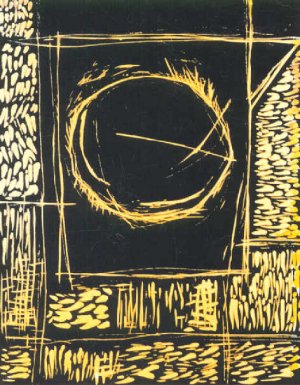
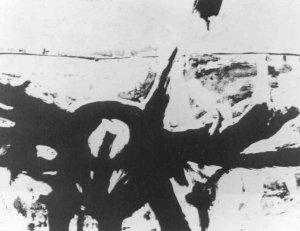
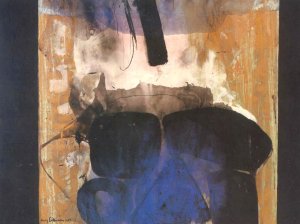
1959 Linocut 45.7 x 35.5 cm. Collection Art Gallery of New South Wales During the transitional period between graphic art and watercolour painting Šalkauskas executed monoprints, e.g. Messenger Arriving, 1961. Here, the soft edges of the mythological image hint of his coming freer mode of expression although the linear composition remains. Šalkauskas said in 1962: 'My work from about 1955 ... is going in two parallel directions. One direction ... is on Nature. The second ... non-objective, free created forms. Now ... those two parallels are somehow combined together.' Šalkauskas found the medium of watercolour in Australia neglected and uninspiring, most watercolourists being concerned only with small, tinted drawings. In 1963, when he joined the Australian Watercolour Institute, he asked, 'Why can't you approach the medium in today's terms?' Šalkauskas's question echoed the sentiments of art critic Adrian Lawlor who earlier had described Australian watercolourists as 'lymphatic'. Šalkauskas's vision was of watercolour being used majestically, daringly and in grand fashion; he began to create huge, dark paintings. He gained a reputation as a 'monumental watercolourist', and considered Sydney's watercolourists to be 'far too cautious in their approach to the medium, too concerned with the production of neat washes of colour and failing, almost entirely, to explore the liquescent possibilities of this subtle and luminous medium.' In his huge paintings, many as large as one metre by two metres, he used mainly black with its shadings and translucency, often juxtaposing this with white. He was influenced by the American 'action painters' of the fifties and sixties such as Mark Rothko, Robert Motherwell, Adolph Gottlieb and Franz Kline. They, however, all used oil as their medium and their work does not show the transparent quality that watercolour alone can endow. Art critic Alan McCulloch writes, 'The work of Henry Šalkauskas means to Australia what the work of Soulages means to France, or that of Kline means to USA.' ![]() Henry Šalkauskas, Untitled, watercolour 1969
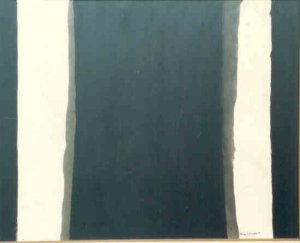
The emotional force of Šalkauskas's work comes sometimes from solid black columns or abstract configurations, as in the Edge of Spring, but more often from the grey, shadowy folds of overlapping veils as in Painting, 1970, where strong black forms ensure permanence and durability. Elwyn Lynn says, 'Henry Šalkauskas's huge watercolours of vast, uneasy, and almost threatening areas of opaque and transparent blacks, greys and "used" or "aged" browns and blues were commanding, thunderous and aimed at the sublime as did much of N.Y.'s Abstract Expressionism a decade before.' Towards the end of his life Šalkauskas returned to a more ideographic representation of Nature in almost pure monochrome of blue or green. This increased the emotional element yet retained the same solemnity and mystery; an example is Untitled, 1969. In contrast to the previously prevailing impersonal sublimity, there is now a preponderance of personal lyricism. The large fields of colour evoke hope, trust and reconciliation, as in Painting, 1979. As well as being more intimate, his last are smaller in scale and somewhat closer to reality, containing more recognisable images of horizon, mountains and meadows. In the fifties Šalkauskas helped to make graphic art a recognised and significant art form in Australia. His impact on Australian watercolour painting is largely due to his huge, monumental works. Art historian Gil Docking says of him: 'Henry Šalkauskas pioneered, in Australia, a new respect for watercolour painting as a medium capable of being used powerfully, expressively and beautifully.' Šalkauskas died suddenly from a heart attack in 1979. Regarded by many as a happy-go-lucky and gregarious person, he was in reality a lonely man who lived, alone and unmarried, in the same house at Kirribilli from the time of his arrival in Sydney, working at the same job -- as a house painter -- and never travelling. His loneliness and private contemplation are reflected in his art work. In 1980 his mother Ona Šalkauskas donated $30,000 to the Art Gallery of New South Wales to establish the Henry Šalkauskas Purchase Award for Contemporary Art. |
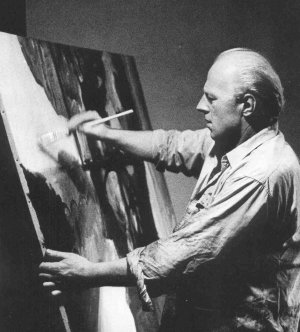
![]() Henry (Henrikas) Šalkauskas, painting.
Photograph by David Moore Twenty five years have elapsed since the death, on 1 September 1979, of Henry Šalkauskas. The Lithuanian community in Sydney lost a trusted and gentle friend, with whom it was so easy to talk about many topics. Australia, Lithuania and, I dare to say, the whole art world lost a talented artist, who loved to create linocuts, serigraphs and water-colour works. His linocuts and serigraphs were mostly in black and white, but some had one or two colours added. After 1965 he concentrated on creating water-colour works. The water-colours were painted in pure, warm colours, or with pastel, gouache and acrylic additions. The works were of considerable size, executed in bold brushstrokes, representing captivating abstract forms. The artists style was abstract expressionism with a visionary quality. I had known Henry Šalkauskas from the mid 1930s. We both attended the Marija Pečkauskaitė High School in Kaunas, Lithuania. ![]() Henry Šalkauskas:
Poignant Memories, linocut 1956 It was Henry who designed the logo of the Lithuanian newspaper "Mūsų Pastogė". His bold lettering is imposing, as he achieved a fine balance of the vertical, horizontal and rounded letter forms. Furthermore, he solved the problem of the different diacritic signs by giving them one common shape. He created many works in Australia. It must be remembered, that for the greater part of this period he worked as a commercial house painter to earn his living. It was physically exhausting work. And yet, his graphic and water-colour works are in the collections of fourteen art galleries in Australia, the Mertz Foundation in New York, the Auckland University in New Zealand and in the Collection of Diaspora Artists in Vilnius, Lithuania. In his comparatively short artistic career he had ten one-man shows and participated in nineteen group exhibitions in Australia. His works were also chosen for fourteen group exhibitions overseas: Japan (4), London and Newcastle (UK), Sao Paulo (Brazil), Ljubljana (Croatia), Lugano (Switzerland), New York, Washington (2), Los Angeles, San Francisco (USA). ![]() Henry Šalkauskas Serigraph, 1963,
Collection Australian National Gallery, Canberra. Mirror Waratah Grand Prize 1963 (First time the prize was awarded to a serigraph). Henry Šalkauskas was a member of CAS (Contemporary Art Society of Australia) Executive Committee, a member of Australia Water-Colour Institute and Foundation Member together with Eva Kubbos and Vaclovas Ratas, of the Sydney Printmakers Society. Thanks to the endeavours of his life long partner and fellow artist, Eva Kubbos, and the generous bequest of Henrys mother, Ona Anna Šalkauskas, the Henry Šalkauskas Biennial Contemporary Art Purchase Award, Art Gallery of NSW was established in 1981. In the Henry Šalkauskas Retrospective 1925-1979, the Director of Art Gallery of NSW, Edmund Capon, said: " To Mrs.Šalkauskas and Eva Kubbos we express our grateful thanks, and the Gallery is delighted to be associated with the name of Henry Šalkauskas, which will be thus remembered in such an appropriate, and valuable, manner." ![]() Henry Šalkauskas Monument, 1967,
Collection of the Art Gallery of New South Wales I would like to end this homage to Henry Šalkauskas with short art reviews by Alan McCulloch and Bernard Smith and the words of his life companion, the artist Eva Kubbos: "He had a great talent for simplicity. Use of space gave small scale media such as water-colour and printmaking remarkable depth and spaciousness. His calligraphic brushstrokes, monochromatic colours and bold presentation were simple, direct and powerful." Encyclopaedia of Australian Art, Alan McCulloch, Hutchinson, 1977 "Henry Šalkauskas, a superb water colourist, located the creative sources of the gesture beyond the gesture itself. Line for him was the language by means of which the tale of creation could be symbolically told." Australian Painters 1788-2000 (updated version), Bernard Smith, Oxford University Press Eva Kubbos remembers him as a wonderful companion and fellow artist who inspired her work. His positive outlook on life and art gave her great strength as a woman and as an artist. She remembers and has missed him for the past twenty-five years. So do Henrys other friends for he was well liked by all. Eva Kubbos indicated that Henrys remaining works belong to Lithuania and that they will eventually reach his homeland. Isolde Poželaitė - Davis AM Sydney 30 August 2004 |
|
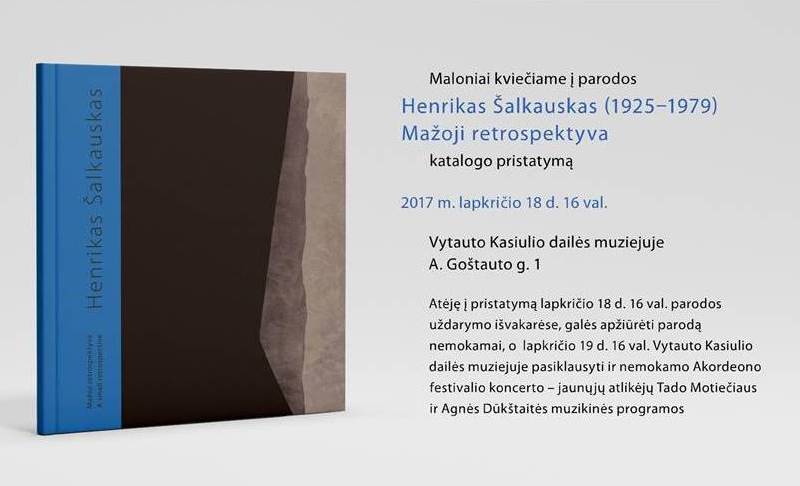
Henriko Šalkausko Mažoji Retrospektyvinė Paroda Vilniuje
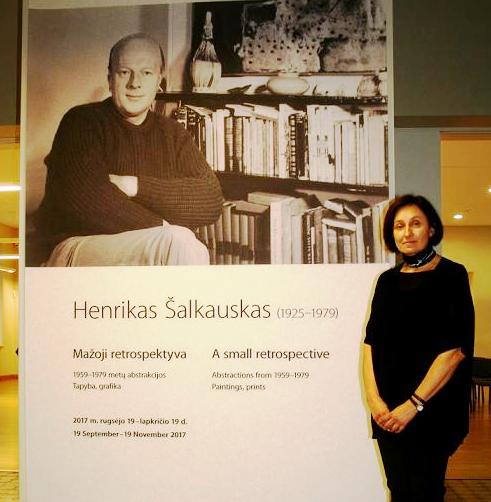
2017 m. rugsėjo 19 lapkričio 19 d. Šių metų lapkričio mėnesį Lietuvos dailės muziejaus Vytauto Kasiulio filiale, Vilniuje, buvo pristatyta mažoji retrospektyvinė Henriko Šalkausko grafikos ir tapybos paroda. Ši paroda tai pirmoji pažintis su Australijoje pripažinto menininko Henriko Šalkausko kūryba Lietuvoje. Buvo eksponuojami 19591979 metais tapybos ir grafikos technikomis sukurti darbai, atspindintys dvidešimt menininko kūrybinės veiklos metų trukusį kūrybinių paieškų kelią. H.Šalkausko kūrinių kolekciją ir dokumentinę medžiagą muziejui dovanojo ilgametė dailininko gyvenimo bendražygė, artima bičiulė dailininkė Eva Kubbos. Trisdešimties kūrinių kolekciją papildė ir menininko kūriniai iš gausaus Lietuvos dailės muziejuje sukaupto išeivijos dailės rinkinio. Pristatydama šią parodą kuratorė Ilona Mažeikienė tarė ...Dailininkas paliko ryškų pėdsaką XX a. antros pusės Australijos grafikos mene. Jis kūrė medžio ir linoraižinius, monotipijas, eksperimentavo su spalvotomis technikomis. Australų kritika dažnai akcentavo H.Šalkausko nuopelnus grafikai, kaip primirštai, antrarūše laikytai dailės šakai, keliant jos kokybę ir prestižą šalyje. Naujojo Pietų Velso galerijos kuratorius Gilas Dockingas teigė, jog H.Šalkausko ir Vaclovo Rato kūriniai ženkliai prisidėjo prie padidėjusio to meto Australijos visuomenės susidomėjimo grafikos menu ir technologijomis. Šilkografijos technika patraukė H.Šalkauską naujomis spaudos galimybėmis, o ja sukurti kūriniai buvo apdovanoti garsiausiuose tarptautiniuose grafikos meno forumuose Tokijuje, Liublianoje, San Paule. Kaip Henrika Šalkauską pažinojusiam man atiteko garbė sudalyvauti parodos atidarymui skirtoje spaudos konferencijoje ir parodos katalogo pristatyme Lietuvos visuomenei. Pasijuto aktyvus ir nuoširdus susidomėjimas ne tik Henriko kūryba ir jo gyvenimu bet ir apskritai apie Australijoje gyvenusius ir kūrusius mūsų menininkus. Paroda buvo lankoma, tačiau dėl esamai mažo Henriko Šalkausko žinomumo lankymo pagreitis buvo jaučiamas labiau į parodos pabaiga; buvo užklausimų dėl ekspozicijos termino prailginimo kad suspėtu daugiau žmonių paroda aplankyti. Henrikas Šalkauskas buvo atradimas parodos lankytojams. Parodos atidaryme kuratorė Ilona Mažeikienė pastebėjo kad lyginant su JAV gyvenusiųjų lietuvių menininkų žinomumu, Australijos lietuvių menininkai visuomenei dar sąlyginai mažai žinomi ir ištirti. Lietuvos dailės muziejaus fonduose stambi Dr. Genovaitės Kazokienės padovanota meno kolekcija. Fondai palaipsniui pildosi naujai dovanojamais meno kuriniais; planuojama 2018m pabaigoje surengti didelę Australijos lietuvių menininkų ekspoziciją LDM Vytauto Kasiulio muziejuje ir išleisti reprezentacinį katalogą. Per spaudos konferencija ir parodos katalogo pristatymą parodos kuratorė, ir Lietuvos dailės muziejaus direktorius Romualdas Budrys, negailėjo šiltų padėkos žodžių Evai Kubbos, ir prie katalogo išleidimo prisidėjusiems. Minėtina ir tai kad medžiaga sukaupta Australijos Lietuvių Metraščiuose šiandiena ženkliai prisideda prie mūsų atminties ir paveldinio palikimo Lietuvai pristatymo. Vytautas Jonas Juška Vilnius 2017 12 11 ![]() ![]() At the opening of Henry Šalkauskas retrospective in Vilnius.
Standing in front is Ilona Mažeikienė, the director of Vytautas Kasiulis Museum. Photo by Vaidotas Žukas, courtesy Vytautas Kasiulis Museum. |