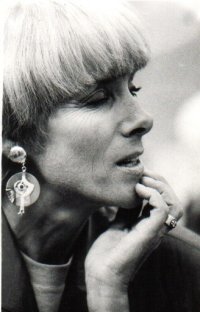
Lidija Šimkutė.
Photo: Ona Pajėdaitė
Photo: Ona Pajėdaitė
Lidija was born in a small village in Lithuania in 1942. She fled Lithuania with her parents in the post WWII wave of political refugees from the Baltic countries. She spent her early childhood in displaced persons camps in Germany and arrived in Australia in 1949.
Immersed in an English speaking environment through her studies at school and tertiary education, she worked professionally as a clinical dietitian in a number of hospitals, with publications in her field. However, at heart she has always been a poet. Lidija’s need to express her inner self in the language of her forefathers spurred her on to undertake a correspondence course in Lithuanian language, literature, folklore and history at the Lithuanian Language Institute in Chicago/USA (1973-78) and then to further her language studies at Vilnius University in 1977 and in 1987.
Thus Lithuanian, her first language learned at home, harmoniously coexists with English, allowing her not only to write and translate the same poem into both languages, but to recreate them with an implied secondary meaning in key words and expressions distinctly original to that particular language.To give but one example of her creative manipulation, let us take the title of her seventeen syllable haiku "Žalias laukas" which the poet recreated into "Greenfield" in the collection Vėjo Žvilgesys - Wind Sheen.The Lithuanian literal meaning of "A green field" has been metamorphosed in English into "a location for any enterprise not previously existant" according to the Collins English Dictionary 2001. This duality, or rather extension, of meanings is very exciting for bilingual readers all the more so, for the imagery is so different in both languages.Thus through its imagery the meaning of both poems diverge at a tangent.
Lidija Šimkutė has so far published seven poetry collections: Antrasis ilgesys (1978, USA), Prisiminimų inkarai (1982, USA), Vėjas ir šaknys (1991, Lithuania), The Sun Paints a Sash (2000, USA), Tylos erdvės - Spaces of Silence.(1999, Lithuania). A selection of her poetry from her three early books was reworked into English by the author and was translated into German White Shadows - Weisse Schatten (2000, Austria) and the Lithuanian counterpart was transalted into Polish Iš toli ir iš arti - Z daleka I z buska (2003, Poland). The bilingual collection Vėjo Žvilgesys - Wind Sheen (2003, Lithuania) is her latest publication. A number of her poems have been translated into ten languages and published in various literary magazines of those countries.
An inherent feature of Lidija’s poetry is a rhythmical and melodious flow. It is, therefore, not surprising that her poems were included in dance performances in Australia and in Europe. The poet has also to her credit many works she has translated into Lithuanian from other languages, among them Australian poetry and prose writings (incl. David Malouf`s An Imaginary Life).
Lidija`s poetry is said to be exclusive and self-referential. Many of her poems give an insight into her inner self and, therefore, they are intimate and sensual. While it is true that in some poems the thoughts and meanings are not single layered and need an intuitive approach and an ability to visualize words, to hear their melody, to savour their scent, but for all that - they are not hermetic. Indeed they are a key that opens into the poet’s world - a rich canvass of her inner feelings, love, spiritual longing, philosophical alusions, transience of life. And above all, an insight into the various times and moods of nature filtered through the poet’s inner eye. Her poetry should be read aloud to bring out the above mentioned qualities.
Lidija’s poems are often quite short and each word is pared to the very core - the essence of its meaning. The poet takes great pains to put her words in the right place to achieve a rhythmic sequence, to enhance a melodious line, or to give them added significance. This is quite a deliberate process in both Lithuanian and English poems. The banishment of punctuation marks, the omission of articles and the novel sentence construction are more prevalent in English verses. And yet, Lidija’s poetry beguiles the reader with its pristine metaphors, emotional depth and esthetic pleasure in its minimalist form.
Lidija’s latest bilingual publication of poems is Vėjo Žvilgesys - Wind Sheen (2003). The expression "Wind Sheen" is evocative of an asp grove with a slight breeze moving its leaves that quiver in a subdued silvery sheen. The collection is dealing with four elements: wood, fire, earth and water and correspond to four cycles: Echo of Trees, Sun Doors, Wind Sheen and Ocean Hum. The poems are arranged thematically, but not rigidly. The length of the poems vary: many are short two liners, others vary between four and fifteen lines. The poem Now that we are parting is an exception, being twenty-two lines long.
Some of her "single breath" short poem verses remind the reader of the Japanese haiku master Basho (1644-94) as in the following example:
PLANK BRIDGE -
clinging for their lives ivy vines |
STARLIGHT
bites through the sky figs hang heavy with sleep |
||
Basho
|
Lidija Šimkutė
|
Lidija’s poems which capture the transience of life and experience can be poignant in their stark imagery like MY FATHER or poetic and melancholy like SEA GRASS and WIND.
MY FATHER
emerged from the coffin and told me it could be mine in the year to come I’m bored he said bellow all is water and above hungry dust he tilted his head by the light of his match I saw neither myself nor another (page 61) |
SEA GRASS
among waves wears out stone I erode my shadow in passing (page 127) WIND shapes thought to the other world I call to the other world I yield (page 127) |
The poet has an aptitude for coining novel metaphors like "hungry dust". One can actually visualise the idea of hungriness as dust swallows everything in its path. She has also the propensity to paint a picture in four short verses, e.g.:
|
" screams are reborn in the froth of the fanged sea" (BIRDS CROSS, page 39) |
Or with just a few brushstrokes: |
"With no sea-gulls in sight the sea stops breathing" (WHITE COLUMNS, page 119) |
Another aspect of Lidija’s poetry are stream-of-consciousness verses in which action is painted through the thoughts of the poet. One such example is:
|
STALKS OF ACHE and ecstasy we hold clouds and feel the languid air take the shape of wings moss ripples whisper and engrave(s) pebbles with passing river song (page 83) |
In summing up Lidija Šimkutė’s original and challenging poetry, I would like to quote a few excerpts of other literary critics, writers and poets and how they have defined Lidija Šimkutė’s poetic oeuvre:
The Lithuanian writer Kazys Bradūnas in the literary supplement of "Draugas" writes:
In the pages of Lidija Šimkutė’s books, one will find gems of real poetry. Colour, feel, dynamism and philosophical implication ignite.
David Malouf in the foreword of Tylos erdvės/ Spaces of Silence writes:
Lidija Šimkutė works as much with space and silence as with words: her poems are full of interstices which light shines through and in which our breath is held as we wait for the next word, the next object, the next bearer of a message, to break through and claim our attention. The poems are larger than their extreme brevity and their few carefully placed words might suggest. The spaces are open views on inwardness. Her words have a shining simplicity and precision.
Christian Loidl, Austrian poet, in "Limes" writes:
Šimkutė’s poetry draws its magic from tension between feeling - strength and mystery. Her poems are permeated with a pagan sense of the sacredness of nature, body and speech with a unity of sensuality and spirituality.
And in the foreword to Weisse Schatten / White Shadows he writes:
Šimkutė moves on the border of disappearance like a Buto dancer above an abyss. The poems strike faster than thought.
Michael Sharkey, Australian poet and critic, in "Ulitarra" writes:
Šimkutė`s poems are unique in contemporary Australian writing. They make no great appeal for attention to the writer`s sentiments; they seem to be perfectly poised enunciations of the mystery and the wonder of being alive.
Lidija Šimkutė’s Website: www.ace.net.au/lidija
Isolde Ira Poželaitė - Davis AM
January 2005
Lidija Šimkutė’s Recent Book ”Mintis ir Uola” - “Thought and Rock”
Lidija’s new poetry book ”Mintis ir uola” / “Thought and Rock” in Lithuanian and English contains about 120 minimalist poems, that is poems pared down to a minimum of expression. The book has been illustrated by Viaceslavas Jevdokimovas-Karmalita and published by Lithuanian Writers Union Publishers, Vilnius/Lithuania, 2008.
The poems are divided into four cycles. They have an echo of seasons in nature. However, it is rather tenuous and implied, rather than expressed in words. All poems are short like a poetic glance at nature, an individualistic thought or a comparison. But they are never inchoate. The poet feels intuitively and knows when to stop writing, nor does she use punctuation marks. It is worth reading her poems aloud in order to get into the rhythm of each one and its counterpart in English. Modulating one’s voice also helps to bring out the suggested emphasis of a word or a phrase.
Her metaphors are fresh, unusual and retain a “Lidija’esque” quality, already noted in previous poetry volumes. Every title is also the first line of every poem. The poet likes to change emphasis and rhythm in her Lithuanian and counterpart English works. This quality leaves a bilingual reader the pleasure and imagination of interpretation. On the other hand, Lidija’s bilingual poems are not verbatim translations of each other. You could rather call them free reinterpretations.
Quite a few of these short poems are enjoyable and inspirational. The noted South African writer and Nobel Prize winner, J.M Coetzee, now residing in Australia, had this to say about the poet’s latest work:
“Thought and Rock” contains poems of remarkable purity, written in a spirit of receptiveness to the world in which the poetic insight suddenly emerges like a bird taking wing.”
Isolde Poželaitė – Davis AM
September 2008
WORD RADIANCE - Ramutė Dragenytė
On Lidija Šimkutė‘s „Mintis ir uola / Thought and Rock“, Vilnius, Lithuanian Writers Union Publications, 2008, 143 pages. Lidija Šimkutė attracts the listener by her presence and the expression of her reading. The intonation that rises from the text forces to alertness and attention in order to experience the aesthetic experience – through sound, vision, movement and flutter of air, something intimate, barely touchable and trembling „someone walked past / and left a warmth behind“ (Winter Sun p.57) „We diminish the crystalline essence with words“ – says Lidija Šimkutė. Perhaps that is why her poetical form is minimal, refined to pure thought. The way the sea polishes rock.
The author has said that the meaning of the word, the sound, intonation and visual expression are important in her work<1> . This is the reason her poetry lends itself to various art form interpretations – her texts have been used in various music compositions and modern dance (Australia and Europe in 2003 ) and choreograhed for a poetical performance with poet reading, modern dance, Shakuhachi (Japanese flute), percussion and art instillation (Vilnius, Kaunas & Klaipeda – Lithuania in 2005 ).
I recollect Lidija‘s reading at the Druskininkai Poetry Autumn, where she read the poem „My Father“. She entered, lay on the stage, slowly rose and read her poem. This gesture was unnexpected to the clamour in the hall and impatient audience.The poet‘s stance and the confrontation of her surroundings intensified the aesthetic expression<2>.
„Mintis ir uola / Thought and Rock“ is the title of Lidija Šimkutė‘s latest book. It‘s written in Lithuanian and English. She is the only author who writes simultaneously in both languages. According to the poet, sometimes the poems come in Lithuanian first, and sometimes in English. It is surprising that L. Šimkutė speaks perfect Lithuanian, although she has lived in Australia since early childhood and has a poetical feel of the lanaguage which often is lacking in local Lithuanian poets. Lidija‘s poetry forces us to appreciate the beauty of poetry for it‘s own sake. To appreciate the text as it is. In contrast to some poets living in Lithuania we do not find any sentimentalism, overstated emotion or exaltation in her poetry. There also is no evident nostalgia nor exaggerated mythologising of Lithuania in her poems, which we find in other poets of her generation living in exile.
The experience of Lidija Šimkutė – living in two cultures, Australia and Lithuania - allows us to call her a world poet (she does not call herself a poet in exile, as her parents fled when she was barely two years old). She is a world poet who is not restricted by any boundaries. She is open to various cultures, new experiences, feelings, and does not have horizon restrictions or complexes that are familiar to us. The wisdom of the world is reflected in her poetry. New experiences become an exotic inclusion for Lithuanian poets, but in Lidija Šimkutė‘s texts this „exotica“ is natural without artificiality, as it grows into the body of the poems and opens symbolic meanings.
A wide view spectrum is also evident in the subject of her poems, which are feminine in the mythological or poetical sense („she walks / dressed in blue / onion peelings“) and have evident strength and insight. However, as a woman, she is not enclosed in her home environment. She is the woman of eternal substance. She spans a wide spectrum of world space, gracing it with universal meaning. Her gestures are meditative. She reads and contemplates signs, insights their meaning, the mystery of life and death. She observes and is sympathetic to the world surrounding her. This sympathy or concern in Lidija Šimkutė‘s poetry is aesthetic and philosophical. It is about impossibilities, sometimes expressed in subjunctive ways („ I would have given / rain / for the coming of rain“)
The overview of the poems subtly move from encompassing all the world to small details. The overall space of the poems is wide and very intimate and also has substantial poetical suggestion.
I THOUGHT of blue flowers covering the world I run outside and pick lavender (p.58) |
There are no allusions, references to specific texts in L. Šimkutė‘s poetry, however the author‘s speech is universal, leans on world experience, or that what C.G. Jung called collective unconscious or archetypes – repetitions of themes, situations and meanings from one generation to another. That is why the motives, images of the poet‘s texts can be associated with the sacred writings of various cultures, philosophy, religion, myths that explain the beginning of time. Lidija‘s poetry touches on the mystery, the world of the dead through memory, symbols (e.g. a medium can be a mirror, heaven / sky or another symbolic image) are the poet‘s imaginative strength. L Šimkutė has written that the marrow of her poetry is the uncosciouss, memory, chance and imagination
The new collection does not differ greatly from L. Šimkutė‘s other poetry books. At least we could say that at first glance. But on deeper reading we observe some characteristic nuances. In the books „Tylos erdvės / Spaces of Silence“ (1999) and „Vejo žvilgesys / Wind Sheen“ (2003) we note that in the titles of the cycles that primal substances are evident: the sea (water), tree (earth), sun (fire), wind (air). In the new collection the cycles also have similar meanings and nearly parallel titles. The question arises, does the author consciously choose these titles or the coincidence is purely that of chance? In the new collection the first cycle of poems is called „Cicada‘s Silence“ (in her „Spaces of Silence“ book there is a cycle of poems bearing the same name as the title of the book). The second cycle „Blue Wind“ (in „Spaces of Silence“ collection there is a cycle of poems called „Purple Hydrangeas“ and in the „Wind Sheen“ book there is a cycle bearing the same name). It seems that the colour blue features in many of the author‘s poems. Blue is a mystical colour and it is often used symbolically in the poet‘s work - the usage of sea, sky and space landscapes. The third cycle of poems in the new book is called „ Skeleton Trees“, whereas in „S of S“ there is a cycle bearing the name „Forest Bones“ and in the collection „Wind Sheen“ there‘ is a cycle named „Echo of Trees“.
Skeleton trees have extended symbolism from the beginning of time to the realities of our present living – trees without leaves evident in this cycle depict the concrete view of NYC with existential neon screams.
The title of the cycle „Cicada‘s Silence“ can be interpreted in two ways. We usually do not speak about what is not there. Silence is an abstract concept. Instead of cicada‘s, one could say the silence of sparrows or grasshoppers – would this name change alter anything in the text? Are there any differences in the nature of silence. (cicada‘s, grasshoppers, sparrows etc.)? The sound image in silence does not change, for there is no sound, only silence. Hence defining silence (cicada‘s silence) does not portray no sound, but an artistic image: we can imagine cicadas that are silent.
CICADA‘S SILENCE encloses dusk doves settle their plumage in your face (p.21) |
Another interpretation unfolds – the state of space when the sound of cicadas ceases, become dumbfounded.. This state of being dumbfounded is the enchantment of L. Šimkutė‘s poetry. The poem is like a momentary static blink, an imbedded image. However, Lidija ‘s poetry is not a static photograph. The framed image which is formed by words makes us speechless. The sound has been turned off, but movement remains.
The state of silence is pertinent to Eastern philosophy which has a different viewpoint of the world. A person who looks out of the window daily, walks the same road, sees the same images daily: trees, flowers, street, people; but in reality he/she does not see anything. It is life‘s backdrop which swims past, but usually does not touch a person‘s consciousness, his/her being. One day when the person stops and looks at the surroundings with attention he /she begins to differenciate and sees the flower, tree and its existence which holds its own unique being, beauty or ugliness. And he / she utters: this is a tree. . . . . . .This momentary inspiration is usually very short and then the world returns to how it was, the sound switches on.
Lidija Šimkutė‘s poetry reminds us of this state. It makes us speechless. That is why it is necessary to read her poetry in silence with attention to sound and image, to whirl around in a circle. If we read the poems quickly as in walking, living beside the world, we will not grasp the meaning of the text. It‘s worth noting the Nobel laureate J.M. Coetzee‘s forward to the book : “Thought and Rock“ contains poems of remarkable purity, written in a spirit of receptiveness to the world in which the poetic insight suddenly emerges like a bird taking wing“. To the Lithuanian or Australian reader, who is accustomed to popular subjects, avant garde experimentation, chaotic expressions with metaphors, this Haiku form of writing may appear too laconic. The reader cannot „grasp“ the text as this type of writing requires reflection and meditation. To write in minimalist form is not easy, as every word has a large semantic load and a radiance not overloaded with metaphors.
Lidija Šimkutė‘s poetry is characterized by a magnetic pull, superlative beauty, expansion and detachment.
SUN SPLINTERS blue tipped pines burgundy maples and saffron birch mushrooms blush in lichen bed dew rolls from moss wood velvet a squirrel‘s dart wakens the gravel path (p.20) |
In the new collection of poems the correlation and link between word and space is evident. The fourth cycle is called „Thought and Rock“ , which is also the title of the book. Thought and rock is the angular key which differentiates this collection from previous books. There‘s more attention given to thought and word. The epigraph chosen for the whole book is a quote from Jelaluddin Rumi „Words come from thought, but where does thought come from?“ As the poem is an affixed image, movement without sound, sound becomes the word itself.
THE SPACE in between gives the words their sound (p.38) |
The voice in the poems, on occasions rising from silence, is connected to primal matter or something intangible. It has has a special quality, mysterious and mystical, which creates a sacral atmoshere. For example „ hears the night / birds cry / calling / souls of passing time“ (p. 128) or
THE FISHERMEN HUM home in early moring fog to wooden houses sunk in fallen apples cut wood breathes smoke and milk fish scale sheen blows onto potato and onion sacks salted nets creak in the wind (p.114) |
Wood breathes, salted nets creak – are such poetical images. The author creates an aesthetic feeling by naming an observation. There are no layered epitaphs – only nets, radiant, clear, a demiurgic pronomolisation, and word becomes body. It could be that knowledge of the English langauge opens the author to such radiant expressions - the syntax of another language and form lends to such a lasting transcultural experience. This poetry is like the pause of a blink, a warm draft from a close one, the cycle of a bird in air, the flight of feathers,
RYE FIELD FACES bare feet sinewy limbs the women from Samogitia work the land into song (p. 17) |
The last lines (work the land into song) can be called a metonymy – whereby instead of saying „the women sing“ - through a metaphor comparison we can hear the whole earth sing. A Lithuanian patriot would say that Lithuania, or more particularly Samogitia, is the land of song. If we turn to mythology we‘ll see mother earth, the symbol of procreation - the uttered song. In another poem we read „ below houses of / ochre and apricot / stirs the underworld“ (p.25) Here we find a chthonic space and there are frequent images of shadows and pro-images from the world of the dead.
The connection of words in „Thought and Rock“ can also disclose another conjugation: thought is rock, thought as rock. Thought that is not formed in words turns to shadow. We could envisage connections to Plato‘s allegory of a rock, but most evident is the power in creating the word – word as body, word spreading light, explaining the meaning of the world, when „unexpectadly / a butterfly‘s flight / tunes language / and makes words dazzle“ (p30). Flight, the stirred air from a butterfly‘s wings gives the impetus to word. It‘s not by accident that the author quotes Sappho „Words that I speak /are only air“.
In Lidija Šimkutė‘s poetry the air flutters, it is mysterious and unable to be grasped. It attracts the listener and makes us speechless. It is radiant with the serenity of the sea or rock‘s breath.
<1> Lidija Šimkutė, “Living in Two Cultures. Poetry‘s Mysterious Source“, Kulturos Barai 2005, no. 6, 44–46 (in Lithuanian). Vilnius Review, Autumn issue 2008 (in English).
<2>This is the way L. Šimkutė read her poem at the Poetry Autumn in Druskininkai in 2004. The poem „My Father“ was short listed in the same year for Poem of the Millenium at the Australian Poetry Festival.,
Translated from Lithuanian and edited by RD & LP „Literature and Art“ Vilnius, October 24, 2008.
Nobel Laureate J.M. Coetzee’s Introduction to
Lidija Šimkutė‘s "Mintis ir uola / Thought and Rock"
At the book’s Australian launch at South Australian Writers’ Centre, Adelaide,on 5 December 2008Lidija Šimkutė‘s "Mintis ir uola / Thought and Rock"
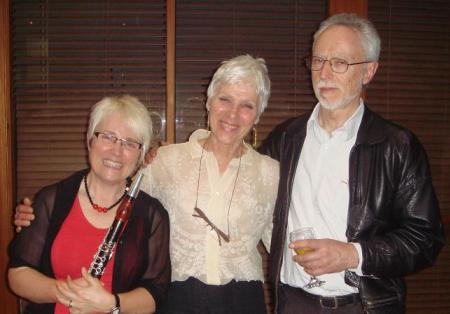
(L-R) Australian composer Margery Smith, Lidija Šimkutė and
Nobel Laureate J.M.Coetzee at the book launch
Nobel Laureate J.M.Coetzee at the book launch
If you take a look at the book, you will notice something unusual about it. It is published not in Australia but in Lithuania. The copies we see here this evening were printed in that far-off land and imported into Australia. So at our launch we have the author present while the publisher is absent. Earlier this year there was a parallel launch in Vilnius at which both author and publisher were present. The double character of the launch reflects the double character of the book itself, half of which is in English, half in Lithuanian. Thought and Rock, says the cover: Mintis ir uola.
I spoke of Lithuania as a far-off land. That may be true, geographically speaking; and the unhappy history of Lithuania in the twentieth century, when it was for a long while swallowed into the Soviet Union, though it has no ancestral links with Russia and Russian Orthodoxy, may reinforce that impression. We tend to forget that Lithuania was once a great power in northern Europe, that its strongest cultural links have been with Catholic Poland rather than with Russia, that among the great poets of the twentieth century two have had Lithuanian roots: Czeslaw Milosz and Tomas Venclova. The former wrote in Polish, whereas the latter who presently lives in the United States writes in Lithuanian.
Let us come back to Australia. When we speak of Australia as a multicultural country, we usually mean that, though the dominant culture is Anglo, or nowadays Anglo-American, other cultures survive beside the dominant one, and are benignly allowed to survive, even encouraged to stay alive – other cultures meaning on the one hand the massive underlying presence of Aboriginal culture, on the other hand a wide range of settler cultures, European, Asian, and now even African.
When we think of these cultures that make up the multicultural mosaic of Australia, what we usually have in mind is language, cuisine, music, folkways, sometimes religion. What we less often have in mind is intellectual culture: art, literature, philosophy.
God knows it has made a great difference to us to be able to go out for a meal and have a dozen different national cuisines to choose among. But that is not the sum total of multiculturalism. It has also meant a great deal to Australia – and now at last I get to the point – that within its immigrant communities there have been individuals who have chosen to keep the intellectual culture of the old country alive in the new country, to report back to the old country on their Australian experience, and in general to act as a bridge or interpreter between the old country and the new.
It is among such people that I number Lidija Šimkutė. Lidija was born in Lithuania during the terrible years of World War II and spent much of her early childhood in DP (displaced person) camps in Germany. In 1949 she and her family arrived in Australia.
Cut off from her native soil, she could easily have turned her back on her origins. Instead, as an adult, she chose to deepen her knowledge of Lithuanian language, literature and folklore, working through the Lithuanian Language Institute of Chicago, the city with the largest and most vigorous Lithuanian population outside Lithuania itself, as well as through Vilnius University.
Lidija’s first collection of poems came out in Lithuanian in 1978 (USA). Her first collection in English (bilingual) came out in 2000 (Lithuania). She has published bilingual editions like the one we are launching today, not only in a Lithuanian/English coupling, but in Lithuanian/German and in Lithuanian/Polish couplings. Individual poems have appeared in translation in no less than thirteen languages.
By profession Lidija has been a dietitian. Since her retirement she has tended to divide her time between Australia and Europe. She has made numerous personal appearances at international poetry festivals. Her poem sequences have been the inspiration for works by composers – among whom is Margery Smith, present with us tonight – and choreographers. Musicians have been drawn to her poetry, I would guess, because of its concision, because of the clarity of its imagery, because of the suggestiveness of its metaphors.
On the one hand Lidija brings us her Lithuanian poems in English translation. On the other hand she takes back to Lithuania her translations of Australian writers, most notably David Malouf. Thus she acts as an intercessor and cultural ambassador in two directions.
In a few minutes Lidija herself is going to take the stage and perform some of her poems for us. There will also be musical interludes by Margery.
We are honoured to have this distinguished international poet among us here in Adelaide, and to be present at the launch of her new book, Thought and Rock.
Lidija Šimkutė‘s "Mintis ir uola / Thought and Rock"
Book Launch at Melbourne Lithuanian House,December 6, 2009
Book Launch at Melbourne Lithuanian House,December 6, 2009
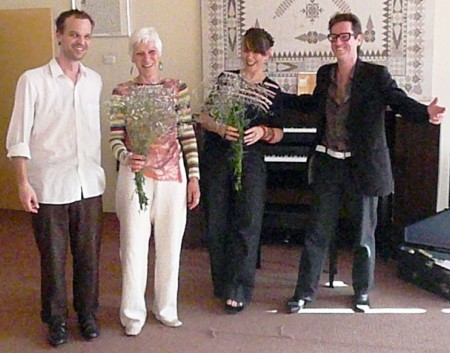
At the book launch in Melbourne – (L-R) Rohan Drape, Lidija Šimkutė,
Jūratė Sasnaitis and Danius Kesminas
Jūratė Sasnaitis and Danius Kesminas
Jūratė Sasnaitis (Greville Street Bookshop proprietor), well known in Melbourne literary circles, read an extract from the review by the writer and critic Edward (Ted) Reilly PhD. Ted Reilly was overseas at the time. Ted is well acquainted with Lidija Šimkutė‘s poetry. He has written and published previous reviews in various lieterary publications and presented her poetry at various conferences in Austrarlia and overseas. He mentioned that “Lidija Šimkutė has taken the hard path outside of the usual post-1960s course of academic writing. She has written poetry over a period of more than thirty years, publishing continuously from her earliest volume in Lithuanian, “Antrasis Ilgesys /The Second Longing” (1978). . . . .Later texts have been bilingual, as with this collection ”Mintis ir Uola / Thought and Rock” (2008). Her persistence in writing and publication over this period is indicative of a singular commitment to a chosen craft and constant refinement of utterance. . . . . To hear and watch Šimkutė deliver her poems in her unique style is to step into a world that has been lost to all but a few.”
At the end of the review reading Algirdas Šimkus presented an overview of Lidija’s biography. After the readings, participants and listeners shared a glass of wine from Barossa Valley – South Australia. Books and CDs were available for purchase.
Algirdas Šimkus OAM
Lithuanian verse at the poetry festival in Scotland
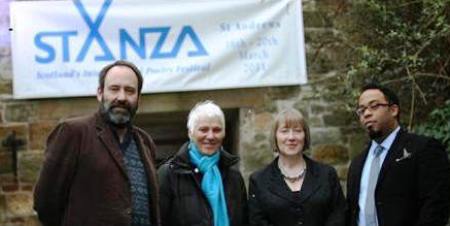
From left: Tom Morton from BBC Scotland, Lidija Šimkutė, director of StAnza,
Eleanor Livingstone, and the American poet Kevin Young.
(Photograph courtesy and (c) D.C.Thomson&Co.,Ltd Dundee Scotland)
Eleanor Livingstone, and the American poet Kevin Young.
(Photograph courtesy and (c) D.C.Thomson&Co.,Ltd Dundee Scotland)
The festival lasting five days in March offers a variety of events. Each year even the regular festival-goers get surprised with some new and unexpected combinations of poetry and music, dance, visual art and cinema. This year‘s StAnza was also celebrating Scotland‘s Year of Food and Drink and you could witness a rather unusual symbiosis of poetry and eating: one could enjoy lunch while listening to poetry or hear an impromptu verse in a café or a shop. The festival takes over the whole historic centre of St Andrews. Its hub - the spacious Byre Theatre houses poetry readings, performances, lectures, discussions and workshops and its two-level foyer welcomes poets and audiences for a chat over a cup of coffee or a glass of wine and Poetry Theatre one-to-one encounters. In the evening the festival disperses into the local cafés and pubs for the Open Mic sessions with jazz interludes, where anyone who writes poetry can go centre stage.
Each year the festival focuses on two major themes. The first one this year was Timepiece, examining the dynamics of poetry and the recorded and unrecorded past, crucial moments in poetry and the everyday routine of nations and communities, both local and distant in space and time.
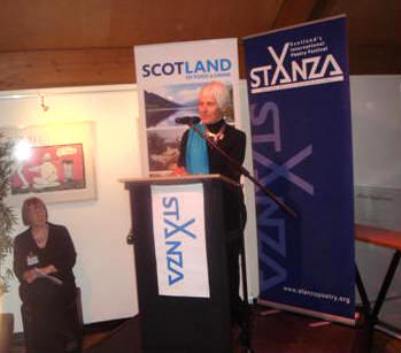
Lidija Šimkutė at the opening of StAnza
This year‘s festival attracted more than one hundred participants: poets, artists, cinematographers, musicians, performers, etc. Among the guests were the Irish poet Ciaran Carson, Britons Paul Farley, Selima Hill, Fiona Sampson, Julia Donaldsson, Americans Marilyn Hacker, Bob Holman, Kevin Young, German Durs Grünbein, Chinese Yang Lian, Iraqi Adnan al-Sayegh, Italian Antonella Anedda and others. It was a pleasant surprise to hear Lithuanian verse at the opening ceremony of the festival. It was read by the Australian Lithuanian poet Lidija Šimkutė. Lithuanian poets are not new to St Andrews. Two years ago among the festival guests were poets Kornelijus Platelis, Sonata Paliulytė and Kerry Shawn Keys, an American poet and translator residing in Lithuania.
Lidija Šimkutė was invited to participate in three events of the festival. One of the popular attractions are Border Crossings readings where two poets, often of different nationalities, read their poetry alongside each other. Lidija Šimkutė read her poems together with the Edinburgh poet Kevin Williamsson. After K. Williamson‘s expressive and at times challenging poems, Lidija Šimkutė‘s laconic and quintessential verse, divided by meaningful silences, was full of insight and reflection, unexpected images and metaphors, and seemed to open the philosophical depths of existence, touched its very beginnings, reflected on the transience of life and time, fragility of human relationship, its beauty and meaning:
|
RUINS OF THE GODS
breathe pigeons the piazza‘s umbrellas stir the gaping crowd as they unsky the dead and we speak with the nameless. |
WHITE NIGHTS
echo voices from gardens of Babylon in memory‘s glass where souls of passing time return for an instant and fade. |
CICADAS SILENCE
encloses dusk doves settle their plumage in your face. |
PETUNIAS
your eyes dissolve into clusters of velvet. |
WHEN THE MOON
rises I‘ll breathe in your sky. |
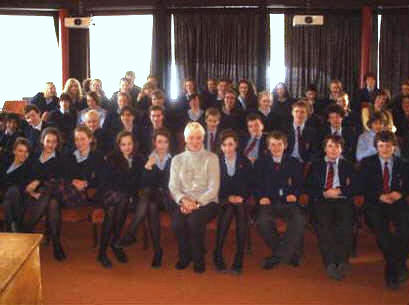
Lidija Šimkutė with the pupils of St Leonard‘s School, St Andrews
Among the favourite events of the festival are Poetry Breakfast panel discussions. Lidija Šimkutė took part in one of them, together with the Gaelic poet Kevin MacNeil, the Australian poet of Macedonian origins Tom Petsinis, and the Scottish poet and translator Don Paterson. Kevin MacNeil had been asked to translate into Gaelic some poems by Lidija Šimkutė and Tom Petsinis. The poets read those poems in the original, then their Gaelic translation was read. The discussion turned out to be very interesting, the poets spoke about their unique bilingual writing experience, Lidija Šimkutė read some poems composed in English and Lithuanian, dealt with their shades of meaning. An hour of discussion went by very quickly and on the way out one of the organizers of the festival, a grey-haired Scott, admitted that he could have listened to this interesting debate on and on.
The fourteenth StAnza ended with cheerful Gaelic music performed by Lurach ensemble, and the poets, having met at the poetic crossroads of St Andrews, dispersed to their home towns and countries, leaving a tiny part of themselves in Scotland: poems still resounding in the audience‘s minds, collections of poetry, audio and video recordings, photos and sketches, which might adorn the Byre Theatre foyer at the next year‘s StAnza. See you then. Let‘s hope that Lithuanian poetry will soon be heard in St Andrews again.
Rasa Ruseckienė,
St Andrews,
May 2011
World Matters Conference “Poetry in many tongues”
Montsalvat, Eltham, Victoria, Australia - October 20, 2012
Montsalvat, Eltham, Victoria, Australia - October 20, 2012
The spacious Barn Gallery, in the beautiful surroundings of Montsalvat, was the setting for a captivating performance presented by two Lithuanian-Australians: poet Lidija Šimkutė and musician Anita Hustas. Reading her poetry in both Lithuanian and English, Šimkutė created spacious, evocative spaces in her poetry, evoking both ancient Lithuanian and timeless contemporary imagery. Hustas provided a seamless backdrop on double bass, moving from deep resonant bass tones to singing harmonics, at times evoking traditional Lithuanian “sutartinės”*. All of the poetry was from Šimkutė's poetry collection 'Thought and Rock', to which the improvised bass proved an ideal backing.
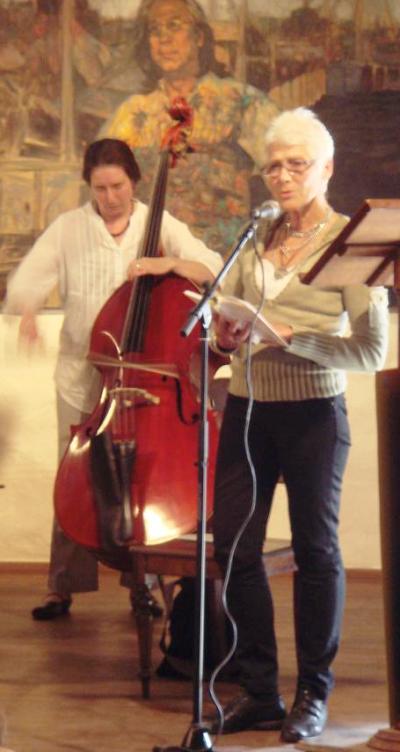
Anita Hustas and Lidija Šimkutė at Montsalavat
'Space gives the words their sound' saw both performers drop back to pure simplicity, the plucked bass resonating through the summer heat, delicately framing the text. 'Cloud-shaped thought' sent the audience gliding off into the clear spring skies, supported by Hustas' elegant long bow strokes.
Šimkutė read each of her poems in English and Lithuanian, giving the audience the opportunity to hear the beauty of the work in both languages, and the subtle shifts in phrasing and meaning. ‘I thought of blue flowers covering the world’ saw Hustas effortlessly moving across her instrument in bold melodic phrases, before settling back to the profound minimalism of ‘When the moon rises I'll breathe in your sky’.
The mood of the performance shifted towards the macabre for the next cycle of poems Skeleton Trees, with Hustas forcing guttural groans and eerie scratches from her bass to introduce ‘Neon Screams’, finding ghostly moans and rattles for 'she ascends / the hill of bones’, and descending to tiny feathering for ‘When You Die’.
The final cycle of poems ‘Thought and Rock’, as the book title re-entered the mood to reflective pastoralism, Hustas returned to evocative long notes before opening out into playful pizzicato, summoning the points of light in the night sky of Šimkutė's ‘Stars Litter // sharpened night sky // tree stump’s fossilized toes / clench earth’s clay / in paralyzed moonlight // words burst / the pine cone’s secret’
The final summation from both artists came with the spacious words of ‘The Breath’ :
|
‘The Breath
in rock mingles with time in sea’. |
Phil Bywater
* polyphonic mantra like vocal chant.Friendly Street Poets nominated Lidija Šimkutė to read her poetry in Lithuanian and English with two other bilingual poets for the World Matters Conference “Poetry in many tongues” in Montsalvat on October 20, 2012. Lidija Šimkutė was accompanied by Anita Hustas, an award winning double bassist, composer, visual and sound artist from Melbourne.
Montsalvat is an artist colony in Eltham, Victoria, Australia, established by Justus Jörgensen in 1934. It is home to over a dozen buildings, houses and halls set amongst richly established gardens on 12 acres of land. Currently Montsalvat's grounds and buildings are mostly used for exhibitions, performances, conferences and seminars.
"Kažkas Pasakyta - Something Is Said"
Extract from Foreword by Tomas Venclova to Lidija Šimkutė's book “Kažkas pasakyta - Something is said“,
Lithuanian Writers Union Publishers, Vilnius, Lithuania, 2013.
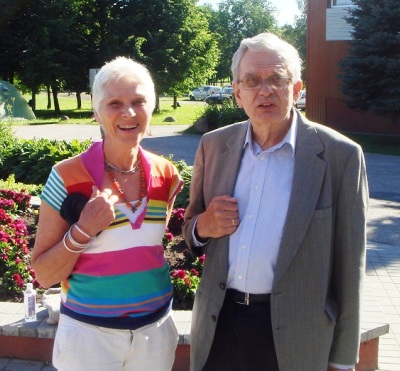
Lidija Šimkutė with poet Tomas Venclova
Someone has said that present day poetry is closer to Li Bo than to Dryden –a form of writing that is laconic, minimalist and meditative, rather than voluble, didactic and rational...... , it‘s evident that Lidija Šimkutė leans towards minimalism which she associates with impromtu, improvisation, the sphere of freedom . . . . . . an Oriental poetry tradition where words are nearly “washed away“ and merge with a gesture, a dance movement, a momentary ritual . This is also evident from the chosen epigraphic quotes. The poems transform into a Kyoto garden surrounded by stones and sand circles that allude to silence and refer to something quintessential, which cannot be completely comprehended and fully expressed in words.
This is a radical and even an extreme path to take. As in all radical forms there lies an underlying risk. Minimalist poems can be concentrated and dynamic, balancing on borders of disappearance, rise in a memorable image, a psychological picturesque gesture, an aphorism – like Basho and the mentioned Li Bo. . . . . . . . . . .Lidija Šimkutė is not afraid to to take a risk and hence often reaches her goal – producing a lucid, elegant and authentic text.
In these texts – modern versions of tankas or haiku – “paper soaks up the remains of an instance“, the boundary disappears between the object and the subject. They both (but only just) disappear. Body – skin, “the moons of fingernails“, bone and breath flow into silence. In silence sound is dormant. In grammar, the first person seeks the second – and finds him, even though it seems an impossibility. The landscape implies transformation or a point of climax.
Extract from “Poetry about things that cannot be expressed” by Regimantas Tamošaitis about Lidija Šimkutė's book “Kažkas pasakyta - Something is said“,
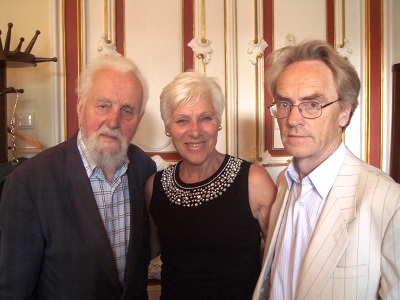
Lidija Šimkutė with Jonas Mikelinskas (left)
and Regimantas Tamošaitis
and Regimantas Tamošaitis
|
ROUND THE SPHERE
of daydreams my curtain self (p 105) |
It’s evident that daydreams - the human or cosmic subjectiveness, the illusory creative force, is Maya’s shroud. But what is behind this shroud and behind the creative stroke - imagination and fantasy? Whose shroud, and what is behind it? In paraphrasing this question in non-Indian (Hindi) gnostic concepts but rather in Grecian terms, what is behind the per–sonos. Whose voice do we hear in the person? In Hindi terms one would answer: nothing. As nothing is everything, and this we call immortality. What doesn’t exist does not die. And what does exist are beautiful illusory similitudes which flutter in space (this incidentally is also the key to the metaphysical reading of Henrikas Radauskas’ poetry). As voice, sound, music - which in essence is melody in the system of relationships. What is left when there is no longer wo/man (? the human being). What remains is language without human meaning, a word – without a body, a melody fading in sacred silence, protecting sound and language as a bird protects its nest. The World is as Something is said. Always – only something, and that’s all, only how much is said (all that is said). The last poem perhaps not unintentionally is philosophical:
|
ERASE WORDS
from memory elsewhere – is here what is not – is born again re-enters every cell and sap from the stamen of sound (p.131) |
This original poem expresses the beginning of being – an archetype astragal, like eidos, like order and at the same time, the primordial sound which creates and unites everything into a wholeness, and reconciles differences. It’s not difficult to feel. One needs to only erase words….. The poet erases these words, purifies them even though what often remains is only radiance from some forgotten meaning.
NEMUNAS July 4-10, 2013 (Translated by L.P.)