
"Eternity" Acrylic on canvas, 900 x 700 mm
Her love for art manifested itself at a tender age. She vividly remembers the bird she drew at the age of six. This picture earned her a great deal of praise and encouraged her to pursue her career in art. So after finishing St Bridget High School in Marrickville, she entered the East Sydney Technical College. After successfully completing the courses, she extended her art studies at the Royal Art Society specialising in landscape painting and portraiture. She also studied painting under Desiderius Orban, Rod Millgate, Allan Hansen, Fred Bates and other prominent Sydney painters.
In 1960 she married, brought up a family of four children and worked for seven years in an art studio doing airbrush painting to reproduce portraits and big paintings of race horses from photographs. This work allowed her to use her creative ability. She represented her subject matter in personalised compositions; carefully choosing angles of vision, colours, shading etc. Very soon she took up landscape and portrait painting in pastels and oils. Her first success was in 1978 when she won the first prize in the portrait section of the Royal Easter Show with a picture of the modern expressionist painter Eva Kubbos (1700x1500). This success was followed by the portrait of the famous soloist Rita Hunter (1800x1500) in 1986. This picture and her portrait of Don Burrows in 1988 were accepted in the Archibald Exhibition Art Gallery of NSW.
Boths portraits were painted in oils. Oil paint was the artist’s preferred medium. It has a great variety of nuances and soft edges that enable the artist to capture facial features and characters of her models. She paints them in a semi realist style against an abstract background. Her treatment of hands and fingers remind me of the loving way Rembrandt painted them in the seventeenth century. The artist’s portraits are imposing, substantial and attest to her mastery in portraiture.
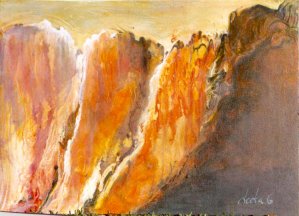
"Catherine Gorge" Acrylic on canvas, 900 x 700 mm
‘It still happens to me’, she says ‘that I start a water- colour picture with a well thought out composition and the painting "takes" over, as if my hand is guided by what the painting "wants" to express.’The artist considers herself as subjugated to the process. As a result the end product turns out to be very different from her first impulses of depicting certain subject matter. Her hand guided by imagination seems to engender unexpected forms and colour schemes. ‘It is fun’ maintains the artist ‘to experience this new and unexpected artistic world’. Nevertheless she can be also disciplined and depict landscapes in a personalised and sublimated style, i.e. she chooses some natural features, leaves out others, plays with shade and full light and, of course, with colours and their nuances.
In her role as a visual arts lecturer who teaches water-colour painting, she has ample

"Jazz Kings" Pastel, 800 x 600 mm
Notwithstanding her success in this medium (she has received over 80 first prizes for her paintings, many of them for water-colours), she has again started to paint in oils with a linseed base two years ago Immediately new themes loomed up on her horizon. She began to portray musical sensations of sounds, rhythms and harmonies in oils and pastels. From an early age she was used to hear music at home played by her mother, a concert pianist. To translate mood and harmonies of sounds in a visual form and in colours became to her a fascinating goal. In order to transfer sounds into a visual form in paint was not easy. Leeka tried various techniques and ways of representation until she felt satisfied with the results. Lately she uses dark vertical and horizontal strokes on the outer part of a quasi halo that become gradually lighter towards the focus of the picture. These ‘sound strokes’ swirl around musicians who are playing slightly off centre in the composition. Thus she has created a series of pictures with music as their theme: The Pianist, Baroque Music Ensemble, Trio Slav,Symphony, Jazz Ensemble. It is most intriguing how she chooses colour schemes for her music pictures, e.g. classical music is painted in sedate colours with a great variety of nuances; joyful Baroque staccato music is painted in light, short clipped strokes; trumpet sounds in jazz music are in vivid even strident colours of bright yellow and orange alternating with purple tones for the saxophone and double bass; melancholy pieces of Chopin are in violet and gray colour tones. An interesting example of her ‘music pictures’ is the portrait of Roger Woodward playing the piano. The artist has captured the pianist’s forceful playing in an intriguing composition of piano keys extending in a round sweep into the periphery. The composition of mainly vertical lines intersected with horizontal ones of the piano and pianist is softened by this round movement of the keyboards and offers the viewer an illusionary perspective of great depth.

"James"
Leeka has again picked up portrait painting in 2002 and has lately portrayed Geoffrey Nicholson (750x650) and Ghilian Helfgott (750x650). In the same year she has also received first prize in the Drummoyne Art Society Show for her appealing landscape picture in oils "Road to White Cliffs" (700x950).
Leeka Kraucevičiutė-Gruzdeff was promoted to Fellow Membership of the Royal Art Society of NSW in 2001. Her pictures can be seen in many local art shows and in private collections in Australia and overseas.
Just lately she has become involved with some colleagues in painting sketches of live models in one, five or ten minutes. The success rate of these sketches drawn in such a short time span is surprising. The artist captures physical likeness and the mood so vividly that one should be forgiven for expecting the models to step out of the picture at any moment. And for her relaxation Leeka has completed a series of abstract paintings of which The Beginning (880x780) is a stunning example.
Leeka Kraucevičiutė-Gruzdeff exhibited her musical sketches and abstract paintings together with three other artists at Cape Cabarita, Philip St, Cabarita on the 17 & 18 November 2002.
Isolde Ira Davis AM July 2002
Musical Moments - Recent Paintings and Drawings
by Leeka Kraucevičiūtė - Gruzdeff
by Leeka Kraucevičiūtė - Gruzdeff
at the NTK Gallery, Croydon, May 7 - 28, 2006

"1920’s Jazz"
In the 50 pictures at the NTK Gallery at Croydon, May 7-28, 2006, the painter Leeka Gruzdeff immersed herself in the exploration and representation of the phenomena between auditory and optical ties that have been with her since childhood. It should be mentioned that her mother was a concert pianist.
The artist uses canvas and paper for her works and acrylic, tempera, chalk pastel and watercolour paints. The pictures vary in size from small works 340mm x 240mm to impressive sizes of 900mm x 600mm. Some have mountings, frames and a covering of glass. The mountings are in harmony with the predominant colour of the pictures. The frames are golden, silvery or of a black-brown colour. Many pictures, especially those painted in acrylic paint, are frameless and all of them depict music, musicians playing a variety of musical instruments, singers and dancers. They are painted in various

"Symphony"
Many pictures have titles used in music, e.g. Gershwin - Rhapsody in Blue. It is a work with a vibrant, pulsating rhythm in blue colours and nuances. The rounded composition enveloped in sound dashes reminds of a whirlwind. The musicians form a circle and some are depicted sitting with their back to the viewer. The double bass gives forth dark blue, deep soft sounds; the piano and harp sounds are in higher registers of a bluish violet colour; the violins play light blue and green cold colour nuances. The latter are in the very middle of the picture. A bleakish mounting, glass covering and a slightly old fashioned golden frame add to the harmony of the picture.
The Tchaikovsky - Flute Sonata, with flutes and cellos, again has sounds of quite different colours. They are light orange, white, joyous, lively of the flutes and dynamic purplish red of the cellos. The Beethoven - Symphony, a masterwork of light, colour and composition, is a deeply felt work, where the dominant background in orange and pinkish hues contrasts well with the darker musicians and their instruments. Looking at the picture one seems to hear the first bars of the composer’s Symphony No 3, "The Eroica" Opus 55, suggested by the white colour streaks, lit from the right side of the picture.
There were many artistic and appealing pictures in the exhibition. However, Bush Band Trio, Banjo and violin, Bush Band Drum surpasses them by the sheer mastery of the artist’s ability to bring to life characters with quick, assured brushstrokes. These pictures captured the essential qualities and features of the Australian "Outback Bush Music" and its balladeers.
Isolde Poželaitė - Davis AM
May 20, 2006