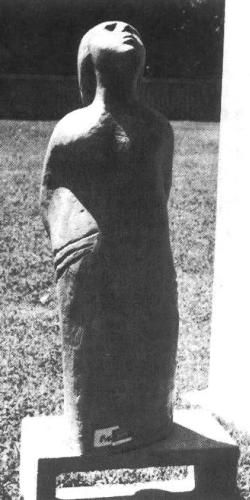
Ieva Pocienė, Hostage
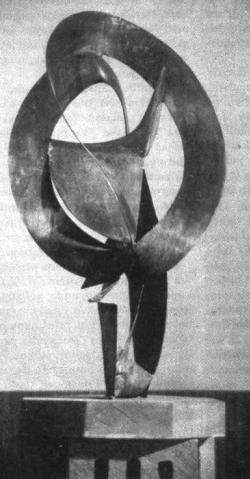
Ieva Pocienė, Double Knot
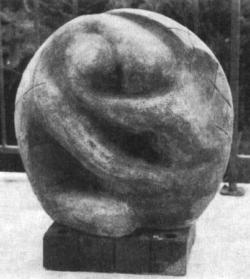
Ieva Pocienė, Medallion
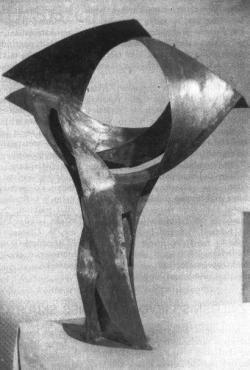
Ieva Pocienė, Water Fountain
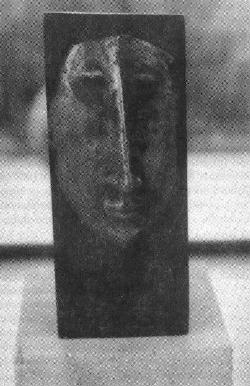
Ieva Pocienė, Madonna of Nostalgia
The sculptor has successfully studied art in Adelaide. In 1962 she obtained her diploma from the Adelaide Art School and then attended special sculpture courses in Salzburg / Austria. She has given sculpture classes in the Art School in Adelaide, organised exhibitions of her works and has won prizes in Australia.
So what is at the core of the sculptor’s art? It has to be said that “window dressing” and clever covering of her ideas and feelings, just because it is avant garde or fashionable, are completely alien to her. Her sculptures are full of life and inspirational flights of her fertile imagination. It is very interesting to watch the interchange of forms and lines: some sculptures soar like Gothic towers harmoniously upwards, others, as if unable to resist terrestrial gravity, are bending downwards. Hard verticality and soft roundness are poles apart, and her art waves through them, or paradoxically creates with them, a harmonious ensemble.
The sculptor likes to get away from realism; however she is not attracted to abstract art per se. Her creative powers spring from the world around her, imagination and an inner world of feelings and ideas. She often discards detailed perfection and portrays only prominent features of a work (eg. The Bird).This is a well balanced composition of space and bent steel lines, which all form the body of the sleeping bird. It is an inert sculpture that implies an innerness and peacefulness. In the Clouds (wrought iron) in my collection the empty spaces are counterbalanced by the round line of the universe and vertical lines of the figure, the big horizontal outline of forehead and vertical nose. This can be seen as the creation of man, or a human being lost in dreams in an immense universe. A hallmark of her creation is the leaving of space for the viewer’s imagination - a common plane between artist and onlooker in which an exchange of ideas can develop.
The artist’s Sitting Girl recalls the feminine world of Renoir pictures. The inside rounded forms of the Medallion echo the outside of the sculpture that can be seen as a warm embrace between mother and child, or of a pair of lovers. The sculpture in cement (ciment fondu) is compelling in its quasi primeval approach. Two other impressive sculptures are Double Knot and Water Fountain, which incorporate space in a most ingenious way and give them an unusual appeal of lightness despite the heavy, solid pedestals. Hostage (cement) is a silent symbol of grief that we see practically everyday on television news. The Madonna of Nostalgia is grief personified. It takes me back in history to the Byzantine world. Its elongated forms of nose and face, sorrowful eyes with traces of tears are juxtaposed to the hard lines of a stark black background. It is like a bas-relief of indescribable loss and loneliness.
The viewer is surprised by the large scale of Ieva Pocius themes: her surroundings, actual events, inner emotions, ideas and philosophical themes are expressed in her works. Her creative works are an important cultural contribution to her homeland and her chosen country Australia.
Isolde Ira Poželaitė – Davis AM Sydney