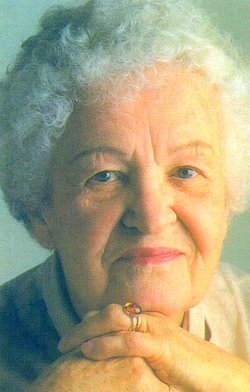
Elena Jonaitis 1997
Elena Kabailaitė Žižienė - Jonaitis was born in Lithuania in 1920. She grew up in Kaunas in the family of colonel Pranas and Adolfina Kabaila, with two younger brothers Algimantas and Vytenis. After matriculating from the "Aušra" high school in Kaunas in 1937, Elena won a scholarship to University of Paris and went there to study French language and literature. However, after two years her studies were interrupted when, having come home for summer holidays in 1939, she could not return to France, as the German invasion of Poland had started and Lithuania’s borders were closed. She was offered a teaching job and taught French in high schools in Pasvalys and, later, Šiauliai. In 1940 the Soviet army invaded Lithuania. The country's dearly won independence twenty years earlier was abolished and repression began in all fields of daily life.
In summer of 1940 Elena married Lithuanian air force captain Vytautas Žižys. They started their married life in Šiauliai, but soon Vytautas was transferred to Ukmergė. Elena could not leave her teaching job and had to stay in Šiauliai. They were reunited at the end of the school year in June, 1941. Together, hiding in a forest outside Ukmergė, they experienced the horror of the first mass deportations by the Soviets of Lithuanians to Siberia. When the German army drove the Soviets out of Lithuania, Vytautas managed to separate himself from his unit and stay in the country. Now he became a civilian and had to look for work.
The couple moved to Kaunas, where Vytautas found a job in a small photographic plate factory. Two children were born in Kaunas: son Arunas in 1941 and daughter Rasa in 1943.
In 1944 the fortunes of war changed. German armies retreated from their occupied Baltic countries, leaving them to the approaching Red army. Many inhabitants, fearing the atrocities of the earlier Soviet occupation, fled westwards. The young Žižys family was among them. More than anything, Elena had feared separation and yet fate did not permit her to avoid it. At the check point on the border, Vytautas was arrested by the Gestapo, and Elena with both her infants was left on the train to go to Austria. Her nightmarish experiences are described in "Elena’s Journey". Vytautas could only rejoin his family at the end of the war in 1945.
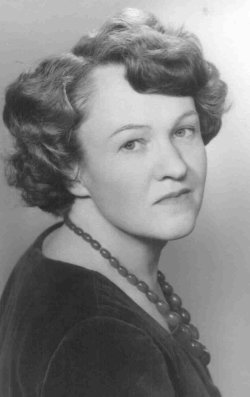
Elena Jonaitis 1958
The bereaved family was allocated to the British ship "Amarapoora" for their voyage to Australia. At the end of October they reached Sydney and were immediately transferred to a migrant camp in Bathurst. In the family, Vytautas was the only one who could speak English and he was appointed to work as one of the camp interpreters. Elena had attended some English language courses in Germany, so she could read, but could not speak English. From the first day she tried to practice the spoken language wherever she could. Having children minors, she was free from the work contract and prepared to stay in the camp as long as Vytautas worked there. Unexpectantly, a Victorian teachers’ agency, to which Vytautas had written from the ship for information about possibilities of teaching in Australia with Elena’s qualifications, had sent a letter from a private Catholic school in Sale, Victoria, offering Elena a job of teaching French in the secondary part of the school. Despite serious doubts and fears, Elena accepted the offer and, taking the children with her, went to Sale. Her Australian teaching career had begun. Without interruption it lasted thirty years. Vytautas for a while stayed in Bathurst. By the middle of the year , thanks to the connections and support of the principal of Elena’s school, Vytautas also was sent to Sale to fulfill his work contract. The family was reunited and stayed in Sale for the next four years. In 1953 a second daughter, Maria Egle, was born. Elena continued teaching. She had also enrolled to study Arts by correspondence in Melbourne University.
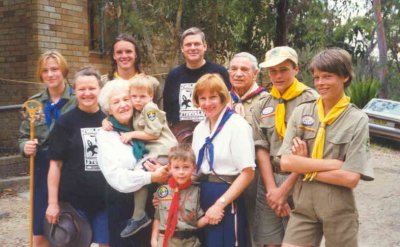
Elena Jonaitis with children and grandchildren at a
scout's camp 1993
In 1963 the illusion of permanency was shattered: Vytautas became ill. After a long and painful illness he died of cancer on 1st August 1963. He was fifty-two.
On 11 December 1965 Elena remarried. Her husband was a Lithuanian architect, Izidorius Jonaitis, who lived in Sydney and was a prominent member of the Sydney Lithuanian community. Elena moved to Sydney with both her daughters. Arunas was already married and stayed in Melbourne. Rasa was still a student, Egle had started high school. Both daughters stayed with Elena and Izidorius until their own marriages. Elena continued teaching 1966 - 1969 in North Sydney Girls HS and 1970 - 1980 in Malvina HS. After retiring from teaching at the age of sixty, Elena did not leave the work force, but worked another ten years as translator and interpreter for the NSW Ethnic Affairs department.
Thirty years of Elena’s second marriage were happy, busy, and comfortable. They were enriched by a large circle of friends and highlighted by travelling in Australia and abroad. Izidorius and Elena renewed and strengthened ties with relatives in Lithuania and America and visited them frequently. They found old friends scattered through the world, made pilgrimages to places they had known in the past, enjoyed touristy discoveries elsewhere. At home, arrivals of grandchildren and their own role as grandparents provided greatest joys of all.
Izidorius died peacefully at the age of 86 years on the 7th June 1995.
For Elena writing was always an integral part of life. From her early age, daily experiences had to be told on paper in diaries, letters and made up stories. Later came articles for Lithuanian newspapers, essays, discussion papers, short and longer stories both in Lithuanian and in English. Some of those stories became "Elena’s Journey" published by "Text" in 1997 and as "Likimo Blaškomi" in a wider version in Lithuanian, published by "Tėvynės Sargas" in Vilnius in 1998.
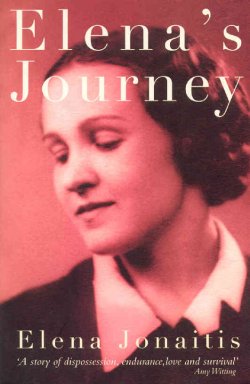
Elena Jonaitis 1997
(From Elena Jonaitis’ address to Melbourne Writers Festival in 1997)
In the last ten weeks since "Elena’s Journey" appeared on the shelves of the booksellers, I have been asked two questions repeatedly: firstly, how was it that I waited till my late seventies to write a first book and, secondly, why in an autobiographical account I used the third person and not the first.
"Elena’s Journey" saw the light of the day almost by accident. My old friend and editor Amy Witting wrote about it in the preface to the book. As for myself, I had started to write my story in 1949 on board the ship bringing my family and myself to Australia. It was not a literary exercise, but the need to record for myself what then was most recent and most painful. It was not intended for any other readers, not even those of my family. Of course, it was written in Lithuanian, my mother tongue. When many years later I used that journal for "Elena’s Journey", it became the end of the book and I felt as if I was telling my story backwards.
On arrival in Australia, for a long time there could be no writing. Every minute of the day and every ounce of energy were used to fitting in, bringing up children, hurriedly learning English, working, studying, becoming Australian. Only when the daily pace could be slowed down, did I find brief moments in which to write.
It was this and that, articles for the Lithuanian papers, speeches, essays, short stories, based on remembered moments of earlier life, usually from that ten year period of changes and wanderings between early young days in Lithuania and a reconstructed life in Australia. Children grew and wanted to know about how and why and what for. More stories came in answer to their questions. Those told orally from time to time came to be written on paper. All in Lithuanian.
Meanwhile, when initial difficulties with English language were overcome, there grew another audience for the snippets of the stories from our past, especially of the war and the postwar times. That audience was my pupils from various schools where I was a teacher. Anything to take the attention off the French irregular verbs, or the Latin declensions! And I must have liked wasting class time talking. At that time I began experimenting in short story writing in English, regardless of shortcomings in fluency and expression.
With the passing of years my children grew and married, had children of their own and began suggesting that I should put together all my stories, the Lithuanian and the English, into one chronological account of that ten year period of our life about which I had been telling. For the grandchildren’s sake this would have to be written in English. Translating felt inadequate. So what I had earlier written in Lithuanian, I retold in English.
To have an honest account, I had to include even those episodes of my life, which I had written only for myself and had not intended to tell my children, or anyone. This was the hardest part, which was started and was left, was picked up and put down again, until finally it was done, enough copies made and distributed to each child and grandchild. My own copy was placed in a drawer and left there for more than a decade. But for Amy Witting’s call last year, it would still be lying there. This is how it took a lifetime to write one book.
Why, when writing, did I use the third person ‘her’ and not the first person ‘me’? This was a decision I had taken from the first. It was not superimposed later when editing, as some reviewers have suggested. Looking at the past after all those years, I could not relate to the young girl, whose story I wanted to tell. I had to distance myself to be able to consider that young person as a separate being. Only then could I begin to sort out some questions about her, to understand the reasons for what she did or did not do, to see how much blame, or leniency, needed to be apportioned to her for all that happened to her and to her family. Above all, I was not able to speak about experienced pain, without pretending that it wasn’t me, but a separate her.
The experiences that I was relating were not exceptional. There were hundreds of thousands of foreigners in postwar Germany in the same situation as my family. They were ordinary people, neither heroes nor villains, caught up in the extraordinary events of the time. Most were young. Uprooted from the established patterns of their daily lives, accepted customs and values, they had to look for ways to adjust and reinvent themselves constantly. Their fate was not often extreme or spectacular. Perhaps that is why their stories were so rarely told. They experienced hunger but not starvation, pain but not torture, humiliation but not murder. The young woman that I was then was one of them. Telling about dislocations, losses, breakdowns in relationships, love grown cold through inflicted separations, or love found where it should not have been, were aspects of experiences of many. My story is a story of many. Telling it, it seemed appropriate to speak of her, not just me.
Reviews of "Elena’s Journey"
‘Immensely readable and moving.’
AUSTRALIAN BOOK REVIEW
‘The story of Elena’s struggle to save herself and her children, first from the Russians and then from the Germans in war torn Europe, renders vividly both the privations and the helplessness of being a refugee. I found her account of the DP camp - its squalor, overcrowding, the whooping cough in children, the lack of privacy and the general sense of helplessness - particularly moving. Equally poignant and frank is Jonaitis’ account of the breakdown of her marriage caused primarily by the pressures of camp life.’
QUADRANT
‘Elena’s Journey is a more structured memoir of wartime dislocation, more personal than political. Jonaitis’ language is simple and unadorned... There is poignancy in her story.’
SUNDAY AGE
‘Traces a particularly eventful and poignant nine years with clarity and a feeling for narrative... Jonaitis has made her journey so much more than a memoir.’
HERALD SUN
‘Personal histories such as Elena’s Journey complement military and political history... They bring alive the experience of war and oppression in a way that big-picture accounts cannot.’
AUSTRALIAN
‘Elena Jonaitis has written an ultimately uplifting book... The work constitutes a significant advance in bringing to a wide audience a different perspective from those currently available of personal narratives that form the kaleidoscope of World War II experiences.’
LITHUANIAN PAPERS
‘Elena emerges as a character caught up in a story unfolding through time and event, whose character is not fixed, but changes and grows.’
SYDNEY MORNING HERALD