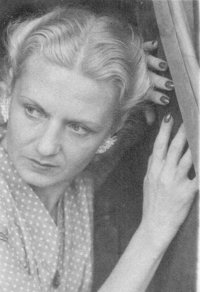
Ksana Dauguvietytė
She was, thus, denied reaching well-deserved fame in her own country. And yet, acting was to Ksana like breathing. She inherited her talent from her parents - her mother, the noted Russian actress Olga Kuzmina, and her famous Lithuanian father, stage director Borisas Dauguvietis. This inherited gift was then molded and honed by other professionals at the Theatre Drama School in Kaunas, Lithuania. She married Viktoras Šniukšta, an economics graduate and administrator in the Public Service, in 1938.
Ksana was a well read, intelligent and sensitive human being, who spoke four languages fluently: Lithuanian, Russian, English and German. Her love for the arts and especially the theatre was abiding throughout her life in her homeland, in exile and in Australia. Alone, or with like-minded friends, she attended mainstream stage and opera performances, whenever opportunities came her way.
In Lithuania she was involved in many plays, first in the State Theatre in Kaunas and, then in 1940, in the State Theatre in Vilnius, which she and other noted actors had founded anew after 20 years of Polish occupation. In a little over three years Ksana was entrusted with major roles in sixteen plays.
In 1944, like many other Lithuanians, Ksana and her husband chose not to remain in Lithuania, soon to be reoccupied by the USSR. On their flight before the advancing Soviet army, they came to Waldenberg in Silesia, where their daughter Maja Victoria was born. As soon as practical, the young family moved closer to the west and settled in Augsburg, Germany. There she joined the Lithuanian amateur theatre, which had just been founded by professional actors in former Lithuania. At the invitation of stage director Henrikas Kačinskas she performed in several plays. Due to unforeseen circumstances she had to move with her family to Neumünster, Germany, where she founded her own drama school. With her budding actors Ksana staged the play "Atžalynas" by the Lithuanian playwright K.Binkis.
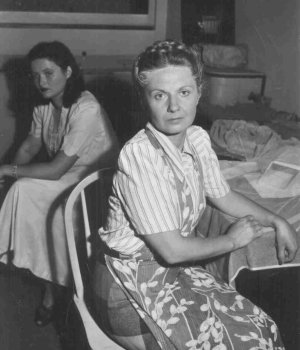
Ksana in "No strangers here" November 1949
During her life in Australia she yearned to continue her acting career. This wasn’t easy. Foreign actors didn’t have many opportunities to act in roles as, in the early 1950s and 60s; their accent was not an asset. Nevertheless, Ksana managed to get the role of a migrant mother in Doc Starnberg’s film "No Strangers Here".
She now concentrated her efforts in furthering the Sydney Lithuanian theatre "Atžala", which she had founded with a few other stage professionals and art lovers. Besides acting in plays, she also directed them. In the 1950s she directed the play "Mokyklos draugai" ("School Friends") by L. Fulda. The premiere was staged in the Capitol Theatre in Bankstown. She played Olwyen’s part in "Dangerous Corner" by J.B. Priestley. To commemorate her twenty-fifth acting jubilee, Ksana directed the play "Šviesi valanda" by K. Winter and acted in it. She also had a part in "The Last of the Red Hot Lovers" by Neil Simon and in other plays between 1955 and the mid 1980s. For her fiftieth acting jubilee in 1982 director Paul Rutenis staged Tennessee Williams’ "Suddenly Last Summer". I vividly remember Ksana playing the part of Mrs. Venable, Sebastian’s mother. This exacting role requires a versatility in characterization, which Ksana mastered perfectly. Sweet and ingratiating at one moment, she changed in turn into a harsh, denigrating and exceedingly proud Southern good-looking matriarch. Her regal bearing, coupled with her refusal to accept any derogatory reference to Sebastian’s life, made her vulnerable and tragic at the same time. She modulated her voice from a high pitch staccato, to a hardly audible low register - while at the same time changing the rhythm of her speech patterns to underline the urgency of the dramatic situation.
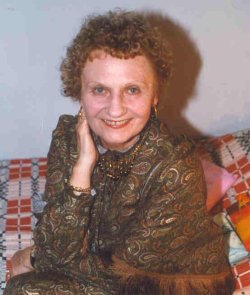
Ksana Dauguvietytė
"A theatre must be an independent entity, not beholden financially to any organisation or the community. The theatre should be subsidised by the community, if it is interested in the survival of the Lithuanian language. For on the stage the public hears the language in its purest form.
Secondly, the capacity of the cast and its actors to perform creditably has to be borne in mind. You cannot stage "Hamlet" without a few good youthful actors.
Thirdly, stage sets and lighting must be uncomplicated. Both demand skill and competence in their execution, not to mention the expense they can incur.
Fourthly, I think that it isn’t important, as some people maintain, to only stage plays by Lithuanian playwrights. The theatre should, as far as possible, endeavour to portray the drama of humankind in its manifold aspects. Therefore, if a Lithuanian playwright has written a play fulfilling the criteria of our theatre in Sydney - well and good. If not, let us stage a play from the world renowned dramatists that suits our requirements".
It seems to me that these realistic, sound and cosmopolitan views admirably portray the persona of the actress and stage director Ksenija Kristina Dauguvietyte - Šniukšta.