The initiative came from Paul Rūtenis in 1982 in trying to re-establish the very old
traditional Lithuanian folksongs. The ensemble "Sutartinė" was formed when a dozen
women, traditional folksong enthusiasts, gathered for the first rehearsal. After only
a year, the group was invited to perform for the Shell Folkloric Festival at the
Sydney Opera House as part of the 1983 NSW Carnivale. The unfortunate death
of the leader Paul Rūtenis did not deter the women but hardened their endeavour
to continue the work already started. During the early years the leaders and singers
continuosly changed. For several years the leader was Eda Kymantaitė-Siutz.
Over many years, the ensemble "Sutartinė" continuously
performed at the various Lithuanian Community events. "Sutartinė" willingly appeared at the
Baltic and Captive Nations commemorations, the opening ceremonies of the Lithuanian
Days festivals and other events. The ensemble "Sutartinė" toured Canberra and Melbourne.
In later years, Rasa Kubiliutė-Mauragienė, an ethnic musicologist from Canberra,
came to help the ensemble. With Rasa’s help a two part concert was organized in
which children and men also performed.
The name "Sutartinė" travelled overseas when a photograph and a
complimentary narrative was printed in the magazine "Achievement" published
by ACH Ltd (in USA). On the 2000 issue of the CD "Lithuanians Abroad", two
"Sutartinė" songs were included: "Kas tar teka, per dvareli" (Three part song)
and "Duno upe, lyio" (Two part song). The "Lithuanians Abroad" series is
published by Antanas Fokas, "Sutaras", Vilnius, Lithuania.
As the Lithuanian language has many dialects, the folk songs reflect the musical sounds
found in these dialects.The songs of Žemaitija (Lowlands) and Aukštaitija (Highlands) are
mainly "homophonic" wherein one part dominates while the others form a basically chordal
accompaniment. Conversly, "polyphonic" songs are formed by the interweaving of several melodic
lines which are independent but sound together harmonious. An example of a
"polyphonic" song would be the hunting song "Laido tėvas sūnelį medžioti" which
is sung by only three women. The "polyphonic" style can also be found in
Lithuanian folkloric instrumental music with instruments such as "skudutis" (
similar to pan pipes ) and "duda" ( pipe ). Men’s polyphonic
ceremonial music is mainly instrumental whereas the women’s polyphonic work
songs are sung by women as they greet the morning on their way to
work in the fields. The "monophonic" style of singing is characterstic of the Dzukija region.
(Source: The book "Lithuanian Folkloric Theatre" by Vytautas Landsbergis)
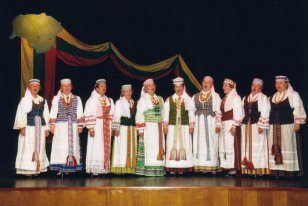
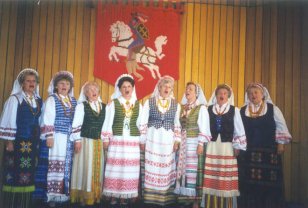
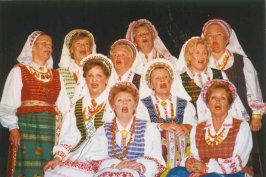
The ensemble "Sutartinė" wear traditional Lithuanian folk costumes or folk dress. The costume
consistes of a headdress, shirt(blouse), bodice, skirt, apron, sash (juosta) and various
necklaces and pendants (mostly amber).The design of the headdress relflects the age and marital
status of the wearer. Girl's headdress includes a coronet (karūnėlė) with ribbons while women's
headdress have a front piece with kerchief or shawl and the wimple (nuometa).
For several years, "Sutartinė" has received financial support from the Australian
Lithuanian Fund Inc. which fosters Lithuanian culture. This financial contribution was a great
help to repair and improve the Lithuanian costumes. "Sutartinė"'s intention is to pass on the
"know-how" to the younger generation.
New members are very welcome to join the ensemble "Sutartinė" and carry on the established
folksong repertoire. Currently the ensemble would welcome a new leader to carry on the work.
|