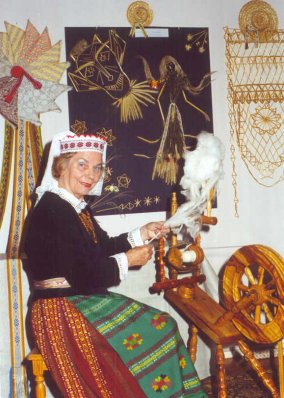
Martina Reisgys spinning
The more organised activities of "Ratelis" formalised themselves after two years. The founders of "Ratelis" were Elena Birkmanis (a director of the Sydney Lithuanian Club at the time), Martina Reisgys and Emilija Šliogeris. We advertised through SBS Lithuanian radio, Lithuanian newspapers and began our work. During the first lessons we wove only sashes, keeping in mind that the sash, woven according to folk traditions, is the oldest type of weaving. We waited to see what would be the response within the community. We got about 20 "pupils", among them not only Lithuanian girls, but also several Australians, one Swede and one German textile specialist, who wanted to get acquainted with Lithuanian folk weaving.
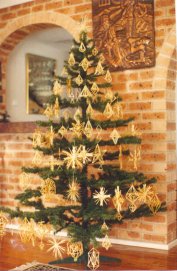
Straw Art decorations
on Christmas Tree
on Christmas Tree
As the years passed, the requirements changed also. Into the activities of "Ratelis" we brought in other folk arts - straw art for adorning Christmas trees and for decorating wedding festivities, Easter egg decorating and many more. We put on folk art exhibits within the Lithuanian community and beyond. Often a display of the life cycle of flax, the so called "life of woe of flax " ("lino muge") was organised, where viewers could see the complete flax life cycle - flax seeds, flax in bloom, flax being gathered, combed flax being spun and finished cloth being woven on a loom.
In the days when Lithuania had still not reestablished its independence away from the Soviet Union, Australians showed a great deal of interest towards Lithuanian folk art. Invitations flooded in from churches, schools, museums and individual persons. Everyone wanted to see the folk art of that unknown country.
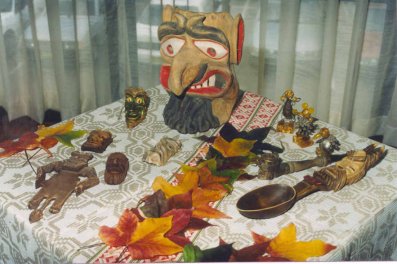
Lithuanian Folk Art
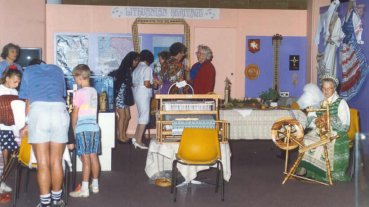
1991 Lithuanian Cultural Heritage Exhibition
at The Australian Museum in Sydney
at The Australian Museum in Sydney
1993, 1994. "Ratelis" put on two day fairs for the Lithuanian community and Australian friends. As well as the numerous folk art exhibits, this time Lithuanian folk songs and Lithuanian cuisine were also introduced. Guests were given a demonstration of the baking of the Lithuanian "tree cake" ("raguolis"). The "tree cakes" on the tables were like a formation of "kings" on a chess board. All this was thanks to our Lithuanian sisters, who having recently migrated to Australia, gladly joined "Ratelis" activities. A guest from the museum kept shaking his head in disbelief as to how the Lithuanians could bake a cake in a horizontal oven!
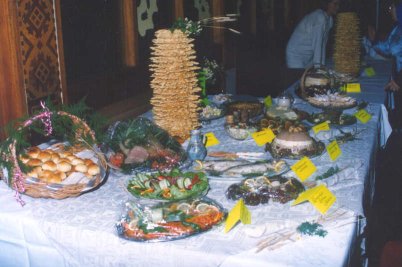
Lithuanian food, with the traditional Tree cake, "Raguolis"
1996. At the beginning of the year there were rumours that Lithuanian orphans were in great need. The "Ratelis" women put aside all folk arts and began a drive to help the needy orphans. They knitted jumpers, caps, socks, "begged" from shops for new clothes, shoes, toys and other items suitable for children. They personally helped out with money, when needed.
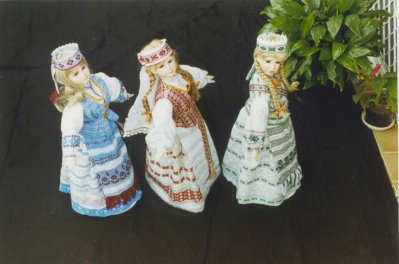
Dolls dressed in Lithuanian National Costume
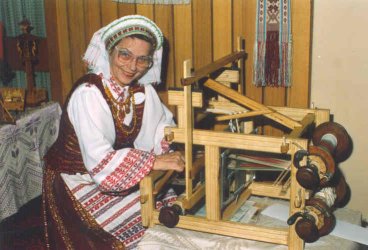
Martina Reisgys weaving
"Ratelis" was a major contributor to the very successful Lithuanian Culture and Folklore Exhibition at Waverley Library in Bondi Junction, March 8 -16, 2003. There were demonstrations of spinning and weaving, straw art making, a performance of Lithuanian music, displays of books, artworks, amber, wooden devil masks. The guests were offered coffee, tea and the famous Lithuanian tree cake "raguolis", which was declared very tasty by all.
"Ratelis" now provides a service in helping with alterations, additions and help with the acquisition of new authentic Lithuanian folk costumes.