
Cecilija in Lithuania

in the AWA radio factory in Sydney (1951)
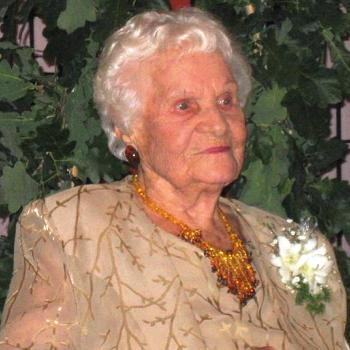
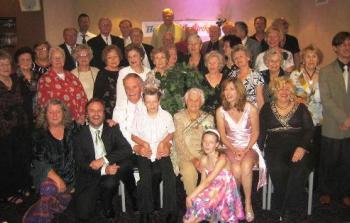
During her 100 year anniversary celebration
with her family and members of the Lithuanian choir
with her family and members of the Lithuanian choir
Mrs Cecilija received many written congratulations - among them from Her Majesty Queen Elisabeth II, the Governor General of Australia Quentin Bryce, the Governor of NSW Professor Marie Bashir, President of the Republic of Lithuania Valdas Adamkus, the Prime Minister of Australia the Hon. Kevin Rudd, Federal parlamentarian Tony Abbot MP, the Premier of NSW the Hon. Nathan Rees, her local State member Kevin Green MP, the Mayor of Hurstville, and the Mayor of Bankstown Tania Mihailuk, who also presented a floral arrangement. Many other well wishers and representatives from Lithuanian organisations wished her good health, happiness and unlimited energy. She hardly misses an event in the Lithuanian Club “Dainava”.
Cecilija’s primary schooling was in Vyžuonos and her high school in the district town of Utena. Her favourite subject was history. (It should be mentioned that students were taught world history in all years of high school). The history course included ancient history, the history of the middle ages, modern history and, of course, Lithuanian history. Cecilija also liked sport, especially running and athletics.
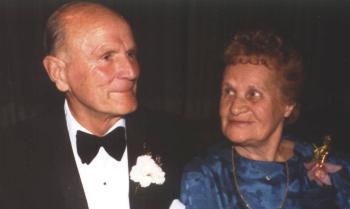
Cecilija with husband Povilas
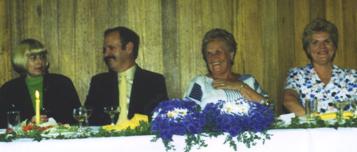
At her 80th birthday celebration with daughter Birutė (on the
right) and son Kęstutis and daughter-in-law Laima (on the left)
right) and son Kęstutis and daughter-in-law Laima (on the left)
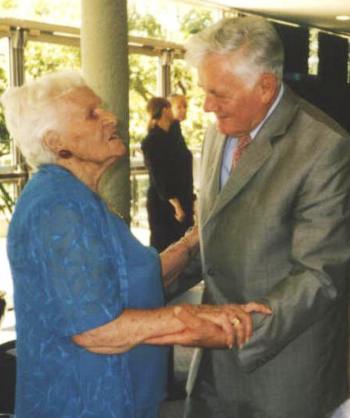
Cecilija meeting President of Lithuania Valdas Adamkus
during his State Visit to Australia in February 2006
during his State Visit to Australia in February 2006
Cecilija’s granddaughter, Venta, studied education at the University of Sydney and graduated with B. Ed. She is teaching science at the Jesuit College St Ignatius in Riverview. Cecilija’s grandson, Antanas, graduated in Health and Building Surveying from the Sydney Institute of Technology. He and his wife, Carolyn (a graduate of the University of Western Sydney), have a Building Consulting business. Antanas and Carolyn have a daughter Claire, 11 years old, and a son, Aaron, who is 9 years old.
Speaking to the interviewer Isolde Ira Poželaitė – Davis AM, Mrs Protas said:
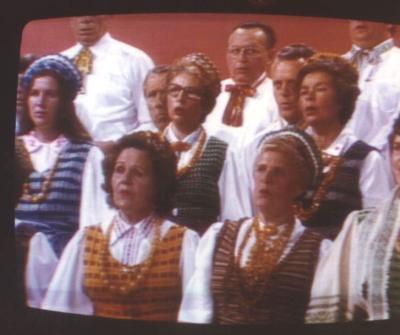
Singing with the “Daina” choir during a Lithuanian Mass televised
by Channel 9. Cecilija is in the first row on the right.
by Channel 9. Cecilija is in the first row on the right.
“To answer your question of why we left our homeland, Lithuania, and fled to the West - we were like thousands of other refugees trying to escape from the Communist regime and the Red
Army, who was again reoccupying our country. My husband had been a senior lieutenant in the Lithuanian army, and as such, was in danger of being deported with his family to Siberia.
Germany was the only country that had a common border with Lithuania and had not yet been occupied by the Red Army. In Germany we lived near Hamburg, which was in the British zone
after the war. We chose to migrate to Australia because it was rather difficult to migrate to the USA.“
“We reached Sydney on 9 March 1949 on the ship “Wooster Victory”. Our journey was very difficult, as the ship was rather small and nearly all the way we had inclement weather with big waves. My daughter Birutė and I were seasick all the way to Sydney. When I was able to spare some time from family duties, I got involved with Sydney Lithuanian community organisations, and from its inception, with the choir “Daina”. I also sang in the Choral Ensemble “Meno Ansamblis”. For a number of years I was the secretary of the Sydney Lithuanian Community Executive.“
“I like to spend my spare time with my family and friends. I also like to read Lithuanian newspapers and good Lithuanian books. I visited Lithuania twice, in 1992 and in 1994. I was particularly happy to see my sister Ona, whom I hadn’t seen for 50 years, and also visit my realatives. In 1994 I attended the “Dainų Šventė”. This song festival reminded me of my youthful years in Kaunas, when my husband Povilas and I sang in the first such festival.“
Interviewer: Thank you, Mrs Cecilija Protas, for this interview, and once again please accept my cordial congratulations on reaching 100 years so gracefully.“We reached Sydney on 9 March 1949 on the ship “Wooster Victory”. Our journey was very difficult, as the ship was rather small and nearly all the way we had inclement weather with big waves. My daughter Birutė and I were seasick all the way to Sydney. When I was able to spare some time from family duties, I got involved with Sydney Lithuanian community organisations, and from its inception, with the choir “Daina”. I also sang in the Choral Ensemble “Meno Ansamblis”. For a number of years I was the secretary of the Sydney Lithuanian Community Executive.“
“I like to spend my spare time with my family and friends. I also like to read Lithuanian newspapers and good Lithuanian books. I visited Lithuania twice, in 1992 and in 1994. I was particularly happy to see my sister Ona, whom I hadn’t seen for 50 years, and also visit my realatives. In 1994 I attended the “Dainų Šventė”. This song festival reminded me of my youthful years in Kaunas, when my husband Povilas and I sang in the first such festival.“
Isolde Ira Poželaitė – Davis AM Sydney, NSW January 2009