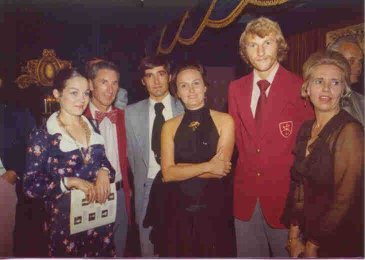
E. Palubinskas - the most famous basketballer in the Australian
Olympic teams at the Munich and Montreal Olympics
The first organised sporting activities among Lithuanians began in Sydney, when the Sydney
Lithuanian Sports Club was established on February 11, 1950. Its president was the
basketballer J. Gruzauskas, who had already been well known in Germany. However, after a
year this club ceased its activities, when on March 4, 1951, with 19 Lithuanian sportsmen
present, a new sports club with the name "Kovas" was established. This name was suggested by
the well-known artist and former basketballer, Henrikas Salkauskas, pointing out that
"kovas", which means a "rook" in English, is a well-known beautiful Lithuanian bird,
possessing both strength and a fighting spirit, qualities which Henrikas wished for the new
club.
In the early days the new club experienced difficulties in surviving and initiating its
sporting activities. It had neither a permanent basketball court, nor money for uniforms or
training. However, the Lithuanian Catholic Chaplain at that time, Fr.Butkus, gave the club
a lot of help. He had been a good sportsman in his younger days and, among the clergy in
pre-war Lithuania, had been the only one, who had satisfied the demanding standards set by
the Physical Education Institute and been awarded their silver medal. He managed to get a
parish hall, took part in competitions and later he was made "Kovas" Honourary Member
No.1.
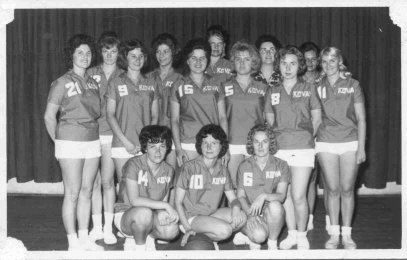
In the beginning several men's (and later women's teams) formed themselves within the
"Kovas" Club. These teams played in Australian competitions, initially in the lower grades
and eventually at the highest levels. Apart from basketball, there were several table tennis,
volley ball, chess and tennis teams, which played well in local Australian competitions and
the Lithuanian festivals. Later, when Lithuanians began to immerse themselves in Australian
sporting traditions, golf became very popular. Just within the "Kovas" golfing section,
there are over 40 players, who take part in Australian and their own competitions.
In addition to sporting activities, this sports club in earlier times also had a folk dancing
group and a drama group, which put on a number of plays.
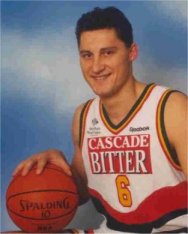
A. Svaldenis - a basketballer with
the famous Sydney "Kings" team
Not so long ago this sports club celebrated the 50th anniversary of its admirable work.
During this time, over 1000 people have been its members, not including numerous supporters.
In 1954 there was formed the Australian Lithuanian Physical Education Union, which included
all of the 10 Lithuanian sports clubs then in existence in Australia. Its first Committee
consisted of "Kovas" members V. Daudaras, A. Laukaitis and V. Sutas. During this 50 year
period the "Kovas" Club membership has included many well known sportsmen and the club itself
has many times won first place in the various branches of sport in a variety of Australian
competitions and the Lithuanian festivals.
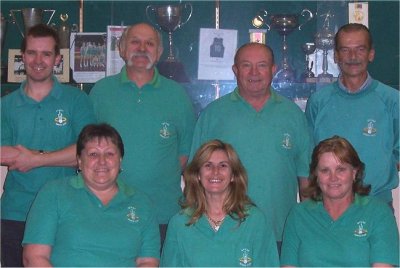
"Kovas" Committee 2005-6: From left: Seated - Rita Kasperaitytė
(Secretary), Anna Šepokas (Treasurer), Louise Šliogeris.
Standing - Petras Burokas, Gediminas Sauka (Vice-president),
Vytautas Burokas (President), Antanas Braželis
To be mentioned among the individual distinguished
sportsmen, who have played for "Kovas", is V.Sutas, who was the very first player in the
Australian national basketball team and its first captain. Others were E. Palubinskas, the
most famous basketballer in the Australian Olympic teams at the Munich and Montreal Olympics;
A. Svaldenis, a basketballer with the famous Sydney "Kings" team; the friend of "Kovas"
friend and famous rugby league player of Lithuanian heritage, T. Raudonikis, and many other
individual "Kovas" players in New South Wales.
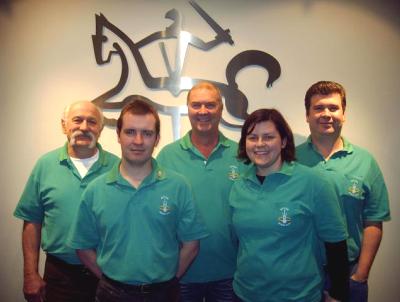
"Kovas" Committee 2007
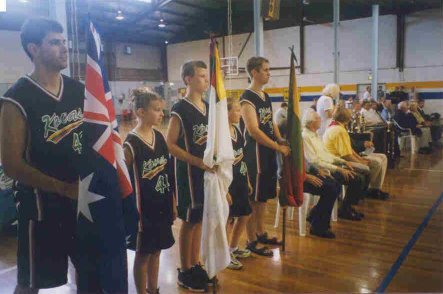
During its 50 year lifespan the sports club "Kovas" not only did not collapse, but attracted
many young persons from mixed marriages, who in spite of a lack of knowledge of the
Lithuanian language, made friends in the Club. Today the strongest youth organisations in
Sydney are the scouts and the sports people, the majority of whom are members of both
organizations and also dance with the folk dancing group.
It is a pleasure and obligation to congratulate our sports Club "Kovas", whose leaders
today are now second or third generation Australian Lithuanians, for fostering the
Lithuanian traditions of their fathers in the sporting field.
|