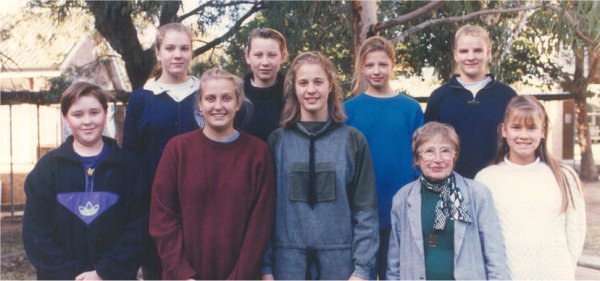
Lithuanian Class Strathfield Centre 1993
First Row (l to r) : Gintas Fraser, Elena Šliogerytė, Audre Venclovaitė,
Aldona Veščiūnaitė - Janavičius (teacher), Jennifer Biretaitė
Second Row (l to r): Audra Dičiūnaitė, Daina Šliterytė, Eglė Gailiūnaitė, Daina Dičiūnaitė
First Row (l to r) : Gintas Fraser, Elena Šliogerytė, Audre Venclovaitė,
Aldona Veščiūnaitė - Janavičius (teacher), Jennifer Biretaitė
Second Row (l to r): Audra Dičiūnaitė, Daina Šliterytė, Eglė Gailiūnaitė, Daina Dičiūnaitė
It is a pleasure to note that the Australian Government, acknowledging the great cultural input that non-English speakers have made to Australia, wants to support and preserve the national and cultural traditions of the various ethnic groups. It also thus encourages and supports the preservation of Lithuanian language in this country.
In class the place of Lithuanian among other world languages is stressed. Historians and linguists over the centuries have researched the origins of Lithuanian language. What is it that amazed them when studying the Lithuanian language? The fact that there exhausts such an original language unlike others (though related to Latvian) and that such a small Lithuanian nation, surrounded by large, powerful countries like Germany, Russia, Poland, has its own unique language, unlike those of its neighbours.
The Sydney Lithuanian Language courses began in 1978 under the auspices of NSW State Education Department. Lithuanian language was included in the Australian Higher School Certificate (HSC) examination, on the same basis as German and French, or other compulsory subjects determined by the Education Department. The number of pupils used to fluctuate between 15 and 36. In the beginning we had two classes - beginners and senior, but as the student numbers gradually became smaller, the beginners' classes in Bankstown were closed due to inadequate numbers (a minimum of 15 students was required).There remained a single class in the Sydney suburb of Ashfield. For several years now we are located in the suburb of Strathfield, in the premises of a girls' high school.
Employing modern teaching methods, pupils are prepared well for the Higher School Certificate (HSC) examination. Every pupil receives individual attention. The main text book is "Introduction to Modern Lithuanian" by Leonardas Dambriunas (Lecturer in Lithuanian at the Vytautas Magnus University in Kaunas), Antanas Klimas (USA) and William Schmalstieg (USA), published by the Franciscan Fathers in USA (1966). Often a good mark in Lithuanian language, taken as a matriculation subject, raises the average matriculation mark and makes it possible to enter the desired course at university. The syllabus is set by a syllabus committee. The 2 unit Lithuanian language HSC exam is of a high standard. Lessons are on Saturdays 8.30 -11.45 a.m. The junior classes work two hours, while the senior classes 3 hrs 15 mins. As Lithuanian language courses are directly under the control of the Ministry of Education, the teachers are paid by the government. The government also pays part of the cost of the textbooks.
The Australian Lithuanian Community and also the Australian Lithuanian Foundation support the Lithuanian language courses in various ways. For example, every year the student with the best marks in the HSC examination gets a monetary First Prize.
Lithuanian language courses were first established in Australia in Melbourne in 1973 and five years later in 1978 in Sydney, as a result of the efforts of Prof. Algis Kabaila and his wife, Vida Kabailiene. Vida Kabailiene was the first teacher, who was helped for a couple of years by a few younger teachers, especially in beginners’ classes. I was invited to take over from Vida Kabailiene, due to her ill health, and here I am still teaching after 17 years since 1980. I teach entirely by myself, though last year I was helped by Jurate Reisgys-Fraser working as a trainee teacher, but this year she has been too busy (family, studies, university).
Again it is necessary to point out that the number of students wishing to take up Lithuanian language is gradually decreasing, but one or two enthusiasts continue to come forward. This year, i.e. 1996, there are 9 students, 5 of whom are high school students of various levels and 4 are adults. The academic year commenced on February 3 and will finish in December.